|
|
Blogroll
|
|
Most recent articles |
|
Highlights |
|
States and Economies |
|
World economies: 15 of 50 largest economies are U.S. States: |
|
World States – Table 1 |
|
History and Society |
|
Fourth of July aboard the W.W. II aircraft carrier the U.S.S. Hornet |
|
A. L. Kroeber's The Civilization of California's Far Northwest |
|
The Arab Admiralty – and an Arab naval view of the Crusades |
|
Excerpt from “The Wife of Bath's Prologue” by Geoffrey Chaucer |
|
“Horsey” Vikings: exploring origin of the “Rohirrim” in The Lord of the Rings
|
|
The Battle of Crécy by Winston S. Churchill |
|
Monotheistic Paganism, or just what was it Christianity fought and faced? |
|
Medieval constipation advice for travelers: “A ripe turd is an unbearable burden” |
|
Alexis de Tocqueville's bicentennial: Anticipatory censorship in colonial America |
|
Antiquity vs. Modernity: Alexis de Tocqueville on the mind of the slaveholder vs. soul of America |
|
Federalism, and Alexis de Tocqueville on the origins of American democracy |
|
Science, Technology, Space |
|
Looking in the right direction – towards the future – with regard to global warming |
|
Know Your Neighborhood: from Andromeda to Fermions and Bosons |
|
Magnetars and Pulsars: Science's special section on pulsars |
|
The Geneva-Copenhagen Survey of Sun-like Stars in the Milky Way |
|
Galactic Central: the Black Hole at the Center of the Galaxy |
|
Politics and War |
|
America’s strong arm, wielding the Sword of Iraq, slays the multi-headed Hydra of Al Qaeda |
|
Regional and Personal |
|
Tamara Lynn Scott |
What wailing wight
Calls the watchman of the night?
William Blake
Whirl is king
Aristophanes
“Jumping into hyperspace ain't like dustin' crops, boy.”
Han Solo, another galaxy
|
Blogroll |
|
Grand Central Station |
|
Legal and Economic |
|
History and Society |
|
Science, Technology, Space |
|
Politics and War |
|
Eclectic |
|
Regional |
|
Reciprocal |
© Copyright 2002 – 2009
Michael Edward McNeil
Impearls: Earthdate 2007-09-29
| Looking in the right direction – towards the future – with regard to global warming |
|
This article utilizes a number of slides/charts deriving from the American Association for the Advancement of Science (AAAS) and their journal Science magazine's 2004 symposium on global warming, Qs and AAAs About Global Climate Change, that was held in Washington, D.C., on June 15, 2004 (earthdate 2004-06-15) — which in addition to providing valuable presentations in their own right (notably not walled-off behind Science’s typically high subscription barrier), have proven fruitful as illustrations of basic science on the topic.
In my view a lot of the argumentation — on both sides — in this great global warming debate has things (at least the overall direction in which folks ought to be looking) precisely backwards. Those people who are generally opposed to the idea that anthropogenic (human caused) global warming is occurring or might be about to occur (anti-AGW aficionados, shall we say) insist that there’s little evidence as yet that what warming has thus far been observed was caused by human activity, and note that the extent of the warming isn’t beyond our historical experience of post ice-age climatic deviations (e.g., the “Little Ice Age” of late medieval/early modern times) which were notably not caused by anthropogenic emission of fossil (formerly sequestered carbon-based) greenhouse gases.
The trouble is, the anti-AGW folks are right; but, unfortunately, the issue having been framed in those terms, scientists who are open-minded about whether anthropogenic global warming is occurring (or at least starting or likely to start occurring) are left scrambling trying to support their hypothesis in a situation where there really is (so far) relatively little such concrete evidence of a long-term global warming trend. Indeed, how could there be? It hasn’t yet gone on for very long.
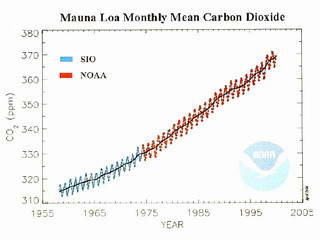
However, as I say, in my view that’s backwards thinking. The reason, I think, why many researchers believe (or ought to) that AGW is beginning to occur in earnest isn’t because much such warming has occurred so far, but rather because human activities are indubitably releasing exponentially increasing quantities of (formerly sequestered) carbon dioxide — a known insulating gas — and other such “greenhouse” gases into the atmosphere.
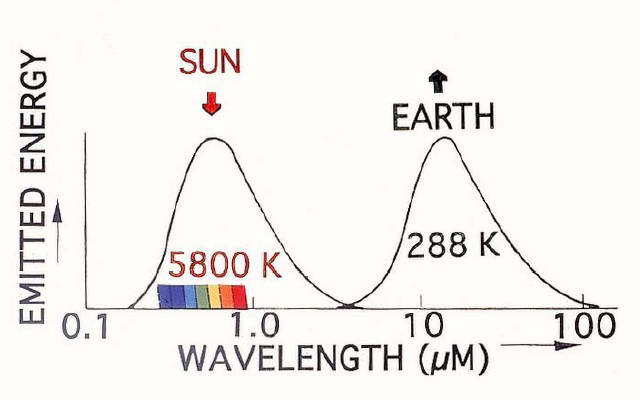
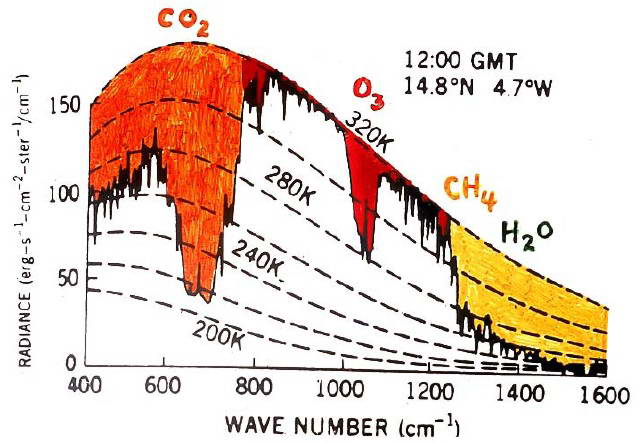
Figures 1 and 2 at top (f1 f2) illustrate how the insulating capacity of greenhouse gases is exhibited: The Sun’s light and heat pours in at a temperature near 5,800 kelvins (i.e., white hot: a thermal frequency band in which greenhouse gases are necessarily transparent), heating up the Earth (located some 150 million km away) to a typical temperature of 288 kelvins (15° C. or 59° F.), which heat must then be re-radiated away to outer space within a far lower (higher wavelength) frequency band — where, fortunately or unfortunately, gases like CO2 lie draped like increasingly heavy blanket curtains over the “window” through which the Sun’s heat must escape — lest the planet warm.
Of course, some extraordinary heat retention is a good thing.
Sherwood Rowland (University of California, Irvine) points out in a slide (No. 24, which we haven’t included) from
his presentation
(pdf) at the aforementioned AAAS symposium, the natural greenhouse effect due to traditional, historic levels of CO2 and other such gases in Earth’s atmosphere is worth a temperature “increase” to our planet (over its blackbody temperature) of some +32° C. or +57° F. — lacking which the Earth would subsist at about 255 kelvins (−18° C. or 0° F.) — on average, well below the freezing point of water.
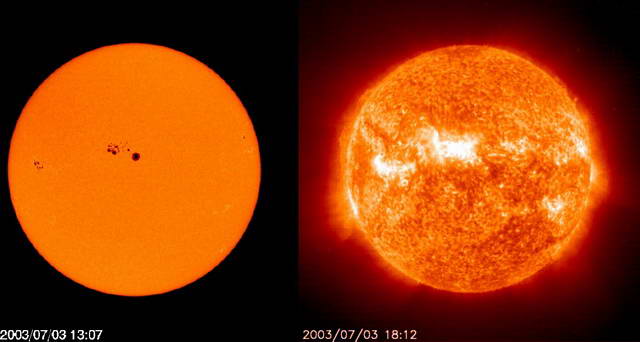
One canard I think can now safely be dismissed: the oft-repeated suggestion which holds (while sweeping the exponentially increasing proportion of CO2 in Earth’s atmosphere figuratively under the carpet) that the warming of the planet seen towards the end of the 20th century and early into the 21st has been entirely (or almost so) due to variations in, and in particular increased radiative insolation from the Sun.
While it’s certainly possible that variations in solar output have influenced climate on Earth (indeed physical theory predicts that the Sun’s average output has increased by about 25% over the span of the last few billion years), that theoretical possibility is quite a distinct matter from the question of whether such changes occur on the Sun on a short enough time scale and moreover that it did in fact occur and was/is the driving force behind what warming has been seen during the last few decades.
Now a study reported in a recent (July) issue of the journal Nature reveals that, contrary to this oh-so-pat hypothesis, solar output has actually observably declined over the last score years, following a peak seen between the years 1985-7. 1 As a result, though some sort of “impedance” effect (whereby the Earth might continue to be seen to warm for a time after the peak of insolation) can be said to be still slightly conceivable at this point, that hope obviously gets increasingly dim the longer (more than twenty years at this point) since the high point of solar output passed.
Beyond that, though one can always imagine scenarios wherein larger heat retention (as a result of increased greenhouse gases) by the Earth might generate, say, greater cloud cover which in the end could actually reflect away more of the Sun’s heat from the Earth — resulting in a cooler climate in general over much of the planet — however, the onset of such a cloudy regimen over great swaths of the Earth would itself imply profound climatic changes, such as would already severely affect extensive regions and populations.
Furthermore, I would adjudge that such suggested scenarios (where “global warming” generates an overall cooling) — while possible — begin to strain likelihood and credibility, as generally in physics when one applies heat to an object (by, say, wrapping an insulator around a heat source, or, equivalently, by erecting a “greenhouse” conveying an insulating effect round about an object which is in range of a radiant heat source), that targeted entity tends to warm up, not cool off. (Ever get into your car after it’s been exposed for a while on a hot sunny day? Same thing, in principle — though it would take a long time for a planet like Earth to approach anything like equilibrium.)
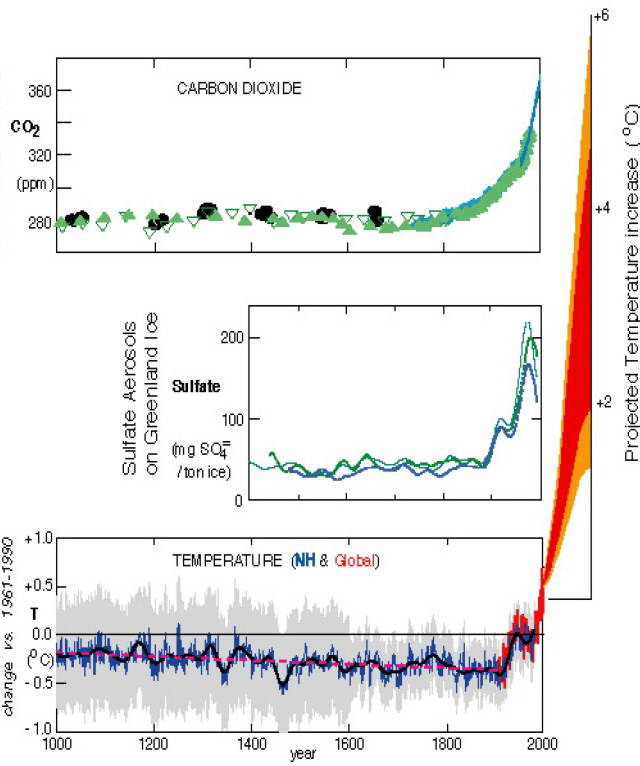
Thus far, I venture to suggest, we’ve progressed insufficiently far up the sharp upwards-pointing “hockey stick” leg of that exponential increase (and a planet like Earth carries a lot of thermal inertia) to see much yet in the way of actual temperature hikes — but the thing about any exponentially increasing function is that, however great a level has been thus far attained, in not too long a time (a few decades to a century or two in this case) it will rise enormously higher still.
The very idea that dumping vast and exponentially increasing quantities of known insulating gases into the atmosphere isn’t going to (eventually) have drastic effects on world climate (even if we don’t understand as yet what all those effects are going to be) is in my view absurd as well as reckless.
Even if, as some idly hope, global warming might turn out (for the moment anyway) to partly counterbalance (or be counterbalanced by) some other effect(s) (such as a possible inclination towards a new ice age at the close of the present “interglacial” epoch), all one must do is simply pour yet another exponential increase in insulating gases into the atmosphere — as will occur unless that exponential trend line is broken — and the result is essentially certain to eventually tip world (and many local areas’) climates into a direction one is generally not likely to like.

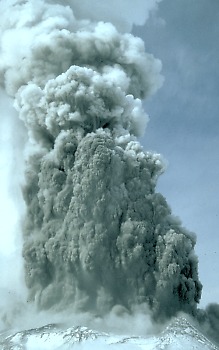
For a concrete illustration as to how far we’ve already gotten up that “hockey stick” exponentially rising slope, one might consider the manner in which many anti-AGW folks often express skepticism with regard to the theory by asserting that any great volcano, such as Mt. St. Helens,
 f7
or Mt. Pinatubo of late dramatic vintage, must, “of course,” vent many times more carbon dioxide and other such greenhouse gases into the atmosphere than all man’s activities put together.
f7
or Mt. Pinatubo of late dramatic vintage, must, “of course,” vent many times more carbon dioxide and other such greenhouse gases into the atmosphere than all man’s activities put together.
While observing the monumental spectacle of incredible volcanic eruptions such as these might make that seem obvious, in actuality, however, the reverse is true. It turns out that all “subaerial” (surficial) volcanoes on the planet put together only spew forth some one four-hundredth (!) the rate of present-day anthropogenic CO2 emissions into the Earth’s air.
(Getting into the nitty-gritty of comparative numerology, according to this research report 2 [see also 3], “subaerial” [surficial] volcanoes on Earth annually produce an average of 34 × 1012 grams of carbon dioxide from “passive degassing,” together with 31 × 1012 grams per year resulting from active eruptions, for a total volcanic emission rate of 6.5 × 10⁷ [65 million] metric tons of CO2 per year. That sounds like a lot, but per the indicated piece that amounts to a mere 0.22% of present levels of human-caused emissions of carbon dioxide — which annual anthropogenic contributions may therefore be calculated to lie in the vicinity of 29 or 30 gigatons of CO2.
We may bring forth another value for anthropogenic CO2 emissions, according to this source, to wit: “Fossil fuels account for most of the 6.5 billion tons [gigatons] of carbon — the amount present in 25 gigatons of CO2 — that people around the world vent into the air every year.” 4 Twenty-five gigatons is 2.5 × 10¹⁰ metric tons of carbon dioxide released every year as a result of human activities, indicating via this figure that volcanoes produce a mere 0.26% of the CO2 that mankind vents into the Earth’s atmosphere.)
According to either value we see that modern-day anthropogenic activities exhaust into the air something like 400 times as much CO2 as all the surficial volcanoes of the world put together. *
Now can folks begin to get a glimmering as to why, with that vast venting of heat-trapping gases, formerly sequestered for millions of years outside the biotic cycle — which human beings are now spewing into the Earth’s atmosphere for basically the first time in the planet’s existence — responsible scientists looking at this situation conclude that the consequences will eventually pose a grave hazard for our earthly environment?
Humans truly are now affecting the entire planet in toto.
*
While undersea volcanoes also contribute somewhat to total planetary volcanic emissions, that isn’t likely to significantly affect the huge disparity between volcanic and anthropogenic volumes of CO2 emitted, not to speak of the large likelihood that most or all carbon dioxide exhaled by volcanoes into the (deep) oceans, remains dissolved in the oceans.
1 Quinn Schiermeier, “No solar hiding place for greenhouse skeptics,” Nature; Vol. 448, Issue No. 9149 (5 July 2007 [2007-07-05]), pp. 8-9.
2 Stanley N. Williams, Stephen J. Schaefer, Marta Lucia Calvache V., and Dina Lopez, “Global carbon dioxide emission to the atmosphere by volcanoes,” Geochimica et Cosmochimica Acta (Journal of The Geochemical Society and The Meteoritical Society); Vol. 56, Issue No. 4 (April 1992 [1992-04]), pp. 1765-1770.
3 Richard E. Stoiber, “Volcanic Gases From Subaerial Volcanoes on Earth,” Global Earth Physics: A Handbook of Physical Constants, AGU Reference Shelf 1, American Geophysical Union, 1995.
4
Robert F. Service,
“The Carbon Conundrum,”
Science
(journal of the American Association for the Advancement of Science);
Vol. 305, Issue No. 5686 (13 August 2004 [2004-08-13])
(“Toward a Hydrogen Economy”
special issue),
pp. 962-963.
Thanks to the American Association for the Advancement of Science (AAAS) and their journal Science magazine for the symposium on global warming, Qs and AAAs About Global Climate Change, that was held in Washington, D.C., on June 15, 2004 (Earthdate 2004-06-15) — which in addition to providing valuable presentations in their own right (notably not behind Science’s typical high subscription barrier), have proven fruitful as illustrations of basic information on the topic.
f1 Sherwood Rowland (University of California, Irvine), “Earth’s Atmosphere: Greenhouse Gases and Global Warming” (pdf), Slide 02 — Charts thermal ‘blackbody’ radiation emitted by the Sun to the Earth, and in turn radiated away (at a far lower temperature) by the Earth to space. Qs and AAAs About Global Climate Change, hosted by AAAS and its Journal, Science, earthdate 2004-06-15.
f2 Sherwood Rowland (University of California, Irvine), “Earth’s Atmosphere: Greenhouse Gases and Global Warming” (pdf), Slide 05 — Chart illustrating blanketing effect that the greenhouse gases (carbon dioxide, ozone, methane, and water) have on the spectrum of thermal energy radiated away by Earth. Qs and AAAs About Global Climate Change, hosted by AAAS and its Journal, Science, earthdate 2004-06-15.
f3 Thomas Crowley (Duke University), “Global Temperature History: The Last Thousand Years” (pdf), Slide 12 — The Sun, as imaged by SOHO (earthdate 2003-07-03). Qs and AAAs About Global Climate Change, hosted by AAAS and its Journal, Science, earthdate 2004-06-15.
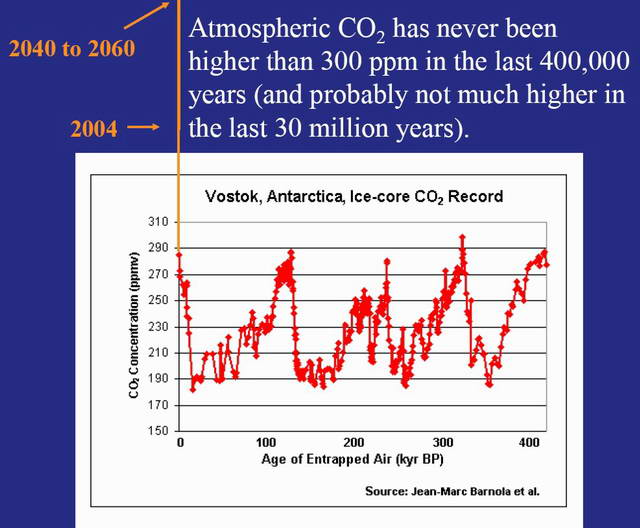
f4 Daniel Schrag (Harvard University), “What Earlier Warm Periods Can Tell Us About the One We’re In” (pdf), Slide 02 — Charts where atmospheric CO2 levels have been for the last 400,000 years, shows where it is now (2004) and will be in 2040-2060. Qs and AAAs About Global Climate Change, hosted by AAAS and its Journal, Science, earthdate 2004-06-15.
f5 Sherwood Rowland (University of California, Irvine), “Earth’s Atmosphere: Greenhouse Gases and Global Warming” (pdf), Slide 04 — Charts monthly mean world carbon dioxide measured at Mauna Loa, Hawaii, between the years 1960 and 2000. Qs and AAAs About Global Climate Change, hosted by AAAS and its Journal, Science, earthdate 2004-06-15.
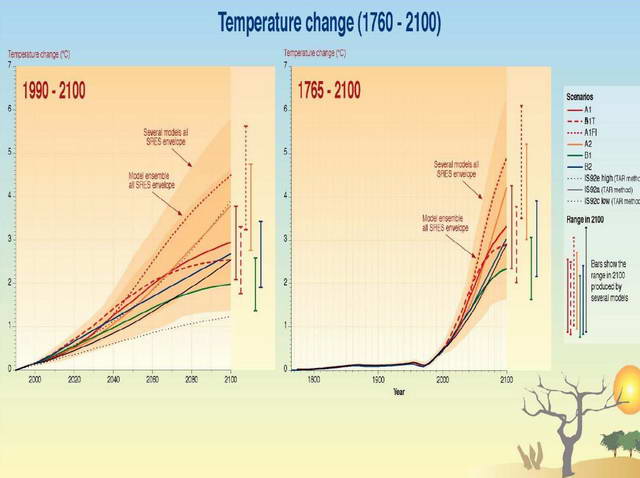
f6 Daniel Schrag (Harvard University), “What Earlier Warm Periods Can Tell Us About the One We’re In” (pdf), Slide 14 — Charts potential carbon dioxide concentrations from 1990 through 2100 according to various scenarios. Qs and AAAs About Global Climate Change, hosted by AAAS and its Journal, Science, earthdate 2004-06-15.
f7 Phreatic eruption, “Mount St. Helens,” Wikipedia.

f8 Joyce Penner (University of Michigan), “Complexities in the Temperature Signal: Aerosols and Trace Gases” (pdf), Slide 16 — Charts carbon dioxide, sulfate, and temperature record over the last thousand years, and projects temperature increases for the future. Qs and AAAs About Global Climate Change, hosted by AAAS and its Journal, Science, earthdate 2004-06-15.
f9 Richard Alley (Pennsylvania State University), “The History of Abrupt Climate Change” (pdf), Slide 26 — Charts temperature change from 1760, extending into the future to 2100 according to various scenarios. Qs and AAAs About Global Climate Change, hosted by AAAS and its Journal, Science, earthdate 2004-06-15.
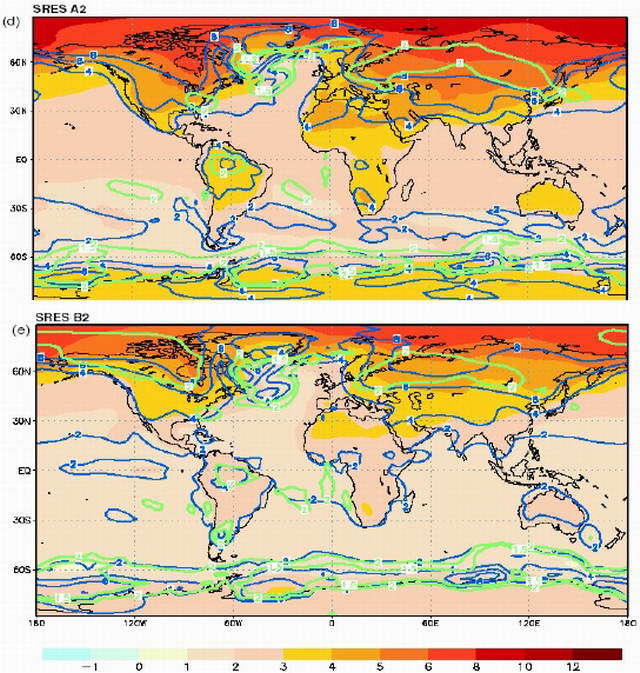
f10 David Battisti (University of Washington), “The Synergism Between Ocean and Atmosphere” (pdf), Slide 03 — World map charts anticipated climate change by the end of the 21st century according to two different scenarios (SRES A2 and B2). Qs and AAAs About Global Climate Change, hosted by AAAS and its Journal, Science, earthdate 2004-06-15.
Labels: carbon dioxide, global warming, science
Impearls: Earthdate 2007-01-23
| Omnilingual – Antikythera Mechanism revealed |
|

A recent issue of the British scientific journal Nature (dated 2006-11-30) has several fascinating articles including a research report on the Antikythera Mechanism, in which a battery of powerful techniques including x-ray computed tomography, high-resolution surface examination together with much painstaking analysis have, more than a century after its discovery at the bottom of the sea, begun to reveal the fascinating secrets of this ancient device. As Jo Marchant puts it in her companion piece “In search of lost time”: 1
It looks like something from another world — nothing like the classical statues and vases that fill the rest of the echoing hall. Three flat pieces of what looks like green, flaky pastry are supported in perspex cradles. Within each fragment, layers of something that was once metal have been squashed together, and are now covered in calcareous accretions and various corrosions, from the whitish tin oxide to the dark bluish green of copper chloride. This thing spent 2,000 years at the bottom of the sea before making it to the National Archaeological Museum in Athens, and it shows.
But it is the details that take my breath away. Beneath the powdery deposits, tiny cramped writing is visible along with a spiral scale; there are traces of gear-wheels edged with jagged teeth. Next to the fragments an X-ray shows some of the object’s internal workings. It looks just like the inside of a wristwatch.
This is the Antikythera Mechanism. These fragments contain at least 30 interlocking gear-wheels, along with copious astronomical inscriptions. Before its sojourn on the sea bed, it computed and displayed the movement of the Sun, the Moon and possibly the planets around Earth, and predicted the dates of future eclipses. It’s one of the most stunning artefacts we have from classical antiquity.
No earlier geared mechanism of any sort has ever been found. Nothing close to its technological sophistication appears again for well over a millennium, when astronomical clocks appear in medieval Europe. It stands as a strange exception, stripped of context, of ancestry, of descendants.
Considering how remarkable it is, the Antikythera Mechanism has received comparatively scant attention from archaeologists or historians of science and technology, and is largely unappreciated in the wider world. A virtual reconstruction of the device, published by Mike Edmunds and his colleagues in this week’s Nature (see page 587), may help to change that. With the help of pioneering three-dimensional images of the fragments’ innards, the authors present something close to a complete picture of how the device worked, which in turn hints at who might have been responsible for building it.
Now that close to a comprehensive understanding of the Antikythera Mechanism has emerged from these studies, the picture of the revealed machine is astounding:
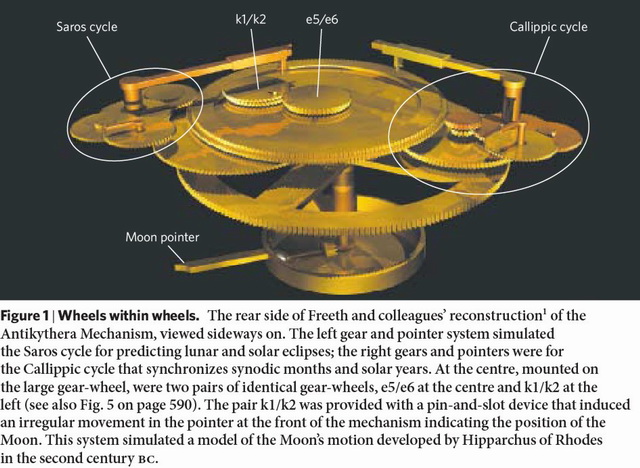
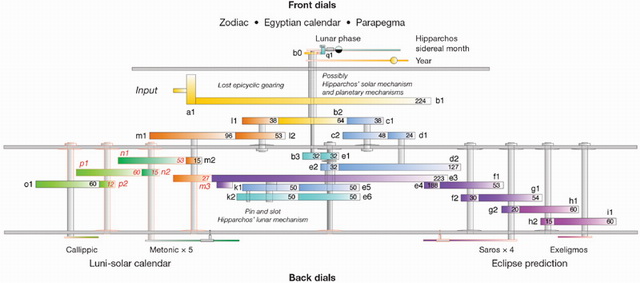
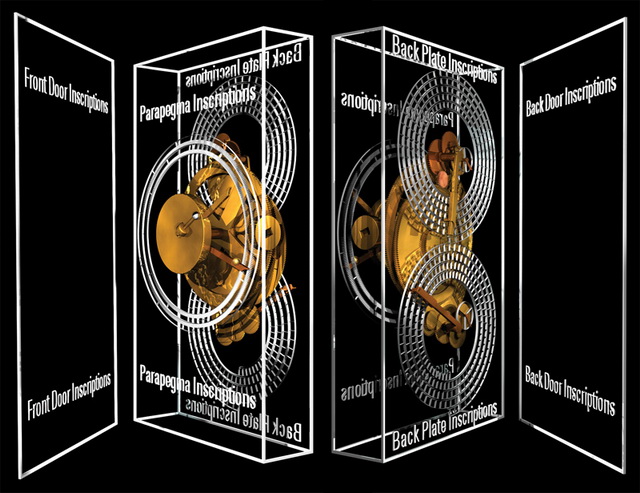
Reading the research report’s description of its analysis of the dials and inscriptions on the device is almost like reading an alternate history novel (a sequel to a book by L. Sprague de Camp, say, The Glory that Was), where science took off in antiquity and all this arcane technology that results is accompanied by an impressive Ancient Greek technical vocabulary… except that this is our timeline.
Prior to historians and archaeologists’ realization of what the Antikythera mechanism really was, scholars had no reason to think that ancients were aware of the principle of clockwork-like complex gearing at all. Via the 1st century b.c. Roman architect writer Vitruvius, we know that simple dual gearing, for directional change, was in use following this time frame in a type of water-powered mill. There are still no instances known of the use of gears of any type predating the Antikythera mechanism, however, nor anything of comparable sophistication for beyond a thousand years after.
A revealing excerpt from the Nature report, “Decoding the ancient Greek astronomical calculator known as the Antikythera Mechanism,” by Tony Freeth (Cardiff University, School of Physics and Astronomy), et al., reads as follows: 2
Named after its place of discovery in 1901 in a Roman shipwreck, the Antikythera Mechanism is technically more complex than any known device for at least a millennium afterwards. Its specific functions have remained controversial because its gears and the inscriptions upon its faces are only fragmentary. Here we report surface imaging and high-resolution X-ray tomography of the surviving fragments, enabling us to reconstruct the gear function and double the number of deciphered inscriptions. The mechanism predicted lunar and solar eclipses on the basis of Babylonian arithmetic-progression cycles. The inscriptions support suggestions of mechanical display of planetary positions, now lost. In the second century b.c., Hipparchos developed a theory to explain the irregularities of the Moon’s motion across the sky caused by its elliptic orbit. We find a mechanical realization of this theory in the gearing of the mechanism, revealing an unexpected degree of technical sophistication for the period.
The bronze mechanism (Fig. 1), probably hand-driven, was originally housed in a wooden-framed case of (uncertain) overall size 315 × 190 × 100 mm (Fig. 2). It had front and back doors, with astronomical inscriptions covering much of the exterior of the mechanism. Our new transcriptions and translations of the Greek texts are given in Supplementary Note 2 (“glyphs and inscriptions”). 2 The detailed form of the lettering can be dated to the second half of the second century b.c., implying that the mechanism was constructed during the period 150-100 b.c., slightly earlier than previously suggested. This is consistent with a date of around 80-60 b.c. for the wreck from which the mechanism was recovered by some of the first underwater archaeology. We are able to complete the reconstruction of the back door inscription with text from fragment E, and characters from fragments A and F (see Fig. 1 legend for fragment nomenclature). The front door is mainly from fragment G. The text is astronomical, with many numbers that could be related to planetary motions; the word “sterigmos” (ΣΤΗΡΙΓΜΟΣ, translated as “station” or “stationary point”) is found, meaning where a planet’s apparent motion changes direction, and the numbers may relate to planetary cycles. We note that a major aim of this investigation is to set up a data archive to allow non-invasive future research, and access to this will start in 2007. Details will be available on www.antikythera-mechanism.gr. 3
The back door inscription mixes mechanical terms about construction (“trunnions,” “gnomon,” “perforations”) with astronomical periods. Of the periods, 223 is the Saros eclipse cycle (see Box 1 for a brief explanation of astronomical cycles and periods). We discover the inscription “spiral divided into 235 sections,” which is the key to understanding the function of the upper back dial. The references to “golden little sphere” and “little sphere” probably refer to the front zodiac display for the Sun and Moon — including phase for the latter.
The text near the lower back dial includes “Pharos” and “from south (about/around) … Spain (ΙΣΠΑΝΙΑ) ten.” These geographical references, together with previous readings of “towards the east,” “west-north-west” and “west-south-west” suggest an eclipse function for the dial, as solar eclipses occur only at limited geographical sites, and winds were often recorded in antiquity with eclipse observations. Possibly this information was added to the mechanism during use.
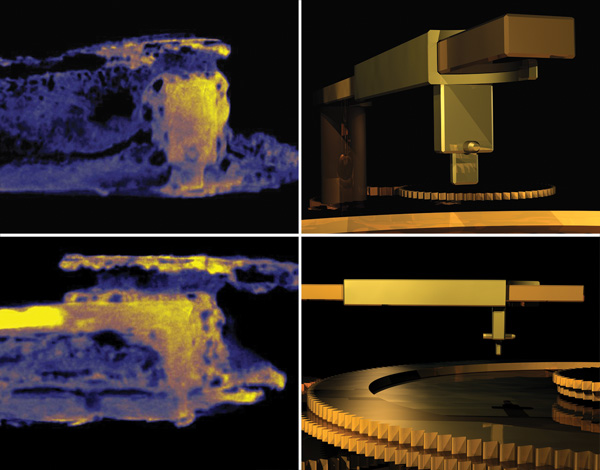
Turning to the dials themselves, the front dial displays the position of the Sun and Moon in the zodiac, and a corresponding calendar of 365 days that could be adjusted for leap years. Previously, it was suggested that the upper back dial might have five concentric rings with 47 divisions per turn, showing the 235 months of the 19-year Metonic cycle. A later proposal augments this with the upper subsidiary dial showing the 76-year Callippic cycle. Our optical and X-ray microfocus computed tomography (CT) imaging confirms these proposals, with 34 scale markings discovered on the upper back dial. On the basis of a statistical analysis analogous to that described for gear tooth counts below, we confirm the 235 total divisions. We also find from the CT that the subsidiary dial is indeed divided into quadrants, as required for a Callippic dial. In agreement with the back door inscription, we also substantiate the preceptive proposal that the dial is in fact a spiral made from semicircular arcs displaced to centres on the vertical midline. In the CT of fragment B we find a new feature that explains why the dial is a spiral: a “pointer-follower” device (Fig. 3) travelled around the spiral groove to indicate which month (across the five turns of the scale) should be read.
From our CT data of the 48 scale divisions observed in fragments A, E and F, we establish 223 divisions in the four-turn spiral on the lower back dial, the spiral starting at the bottom of the dial. This is the Saros eclipse cycle, whose number is on the back door inscription. The 54-year Exeligmos cycle of three Saros cycles is shown on the lower subsidiary dial.
Between the scale divisions of the Saros dial we have identified 16 blocks of characters, or “glyphs” (see Supplementary Note 2 (“glyphs and inscriptions”)) at intervals of one, five and six months. These are eclipse predictions and contain either Σ for a lunar eclipse (from ΣΕΛΗΝΗ, Moon) or Η for a solar eclipse (from ΗΛΙΟΣ, Sun) or both. A correlation analysis (analogous to DNA sequence matching) with historic eclipse data (all modern eclipse data and predictions in our work are from this reference) indicates that over a period of 400-1 b.c., the sequence of eclipses marked by the identified glyphs would be exactly matched by 121 possible start dates. The matching only occurs if the lunar month starts at first crescent, and confirms this choice of month start in the mechanism. The sequences of eclipses can then be used to predict the expected position of glyphs on the whole dial, as seen in Fig. 4. The dial starts and finishes with an eclipse. Although Ptolemy indicates that the Greeks recorded eclipses in the second century b.c., the Babylonian Saros canon is the only known source of sufficient data to construct the dial. […]
Of particular note is the dual use of the large gear, e3, at the back of the mechanism, which has found no use in previous models. In our model, it is powered by m3 as part of a fixed-axis train that turns the Saros and Exeligmos dials for eclipse prediction, and also doubles as the “epicyclic table” for the gears k1, k2. These are part of the epicyclic gearing that calculates the theory of the irregular motion of the moon, developed by Hipparchos some time between 146 and 128 b.c. (ref. 22) — the “first anomaly,” caused by its elliptical orbit about the Earth. The period of this anomaly is the period from apogee to apogee (the anomalistic month). To realize this theory, the mean sidereal lunar motion is first calculated by gears on axes c, d and e and this is then fed into the epicyclic system. As explained in Fig. 6, a pin-and-slot device on the epicyclic gears k1 and k2, clearly seen in the CT, provides the variation. This was previously identified, but rejected as a lunar mechanism. The remarkable purpose of mounting the pin-and-slot mechanism on the gear e3 is to change the period of variation from the sidereal month (that is, the time taken for the moon to orbit the Earth relative to the zodiac), which would occur if k1 and k2 were on fixed axes, to anomalistic month — by carrying the gears epicyclically at a rate that is the difference between the rates of the sidereal and anomalistic months, that is, at the rate of rotation of about 9 years of the Moon’s apogee.
Gears with 53 teeth are awkward to divide. So it may seem surprising that the gearing includes two such gears (f1, l2), whose effects cancel in the train leading to the Saros dial. But the gearing has been specifically designed so that the “epicyclic table” e3 turns at the rate of rotation of the Moon’s apogee — the factor 53 being derived from the calculation of this rotation from the Metonic and Saros cycles, which are the bases for all the prime factors in the tooth counts of the gears. The establishment of the 53-tooth count of these gears is powerful confirmation of our proposed model of Hipparchos’ lunar theory. The output of this complex system is carried from e6 back through e3 and thence, via e1 and b3, to the zodiac scale on the front dial and the lunar phase mechanism. Our CT confirms the complex structure of axis e that this model entails.
The Antikythera Mechanism shows great economy and ingenuity of design. It stands as a witness to the extraordinary technological potential of Ancient Greece, apparently lost within the Roman Empire.
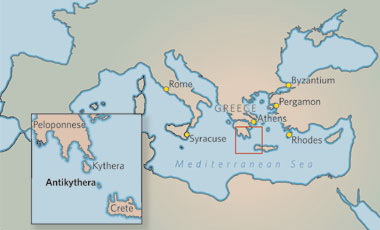
Intriguing questions demanded by the mere existence of an ancient device of the sophistication and elegance of the Antikythera mechanism, of course, include where did it come from, and who built it? The wreck on which the toponymically named mechanism was found, had foundered off the island of Antikythera, lying at the western extremity of the Aegean Sea directly astride important trade routes connecting the Aegean — places like Rhodes, a principal trading entrepot, along with points east and north (e.g., Pergamon) — with the western Mediterranean, most importantly the city of Rome itself. Given the cargo of luxury goods aboard (originating to the east of the ship’s final resting place), it seems very likely that the vessel was indeed bound west, quite probably for Rome, when it abruptly sank in 42 meters (138 feet) of water.
Where then did the mechanism originate and who might have made it? A clue is provided by the fact that in addition to the famous mechanism the ship also carried luxury trade goods which have been identified as originating at Rhodes, as well as other goods that are from Pergamon but which may have been transshipped through Rhodes. As noted before, the Antikythera device itself contains an algorithm built-in to express the “first anomaly” of lunar motion which was worked out in the 2nd century b.c. by the Greek astronomer Hipparchos — perhaps greatest of ancient Greek astronomers; who indeed did much of his work at Rhodes — and on which island afterwards the philosopher Poseidonius (contemporaneously regarded as the most learned man of his age; who did astronomical work himself, and at one point instructed Cicero at Rome) established a school.
Hence the hypothesis that Poseidonius’ school at Rhodes developed the technological traditions — that may have been directly influenced by Hipparchos himself, and which must have taken a good long while to gestate, as the Antikythera mechanism clearly didn't spring whole-cloth out of nowhere — leading to the construction of the machine and others like it; one of which was sent off to Rome.
It never made it, and the rest is (latter day) history.
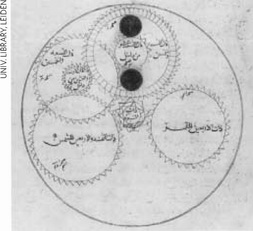
Beyond its jaw-dropping technology and fascinating provenance, the question of what effect the discovery and decipherment of this ancient technology has on our understanding of history itself, as Jo Marchant observes in her Nature companion piece, is perhaps even more intriguing. As she notes, prior to the Antikythera device it was believed that the advent of clockwork-type mechanisms in 14th century Medieval Europe represented the invention of this fundamental technology at around something like that time frame. Since Antikythera, however, a geared 6th century a.d. Byzantine sundial with four surviving gears (and which probably originally incorporated at least eight) has turned up; 4, 5 while the Medieval Persian scholar/scientist al-Biruni described a “box of the Moon” that is quite like the Byzantine device. (See at right an illustration of an eight-geared lunisolar calendar from al-Biruni’s astrolabe treatise of 996 a.d.) Such an augmented astrolabe from 13th century Iran is still extant today. The step from that to the clocks of 14th century Europe is chronologically and technologically short.
Thus, the history of gearing and clockwork is being revolutionized. Instead of originating late in the Medieval era, as previously assumed (in a form we now see as suspiciously like that of the Antikythera mechanism), now it appears likely that the tremendously sophisticated gearwork that we see reflected in this machine continued to survive in some form in the Greco-Roman world, as displayed in the 6th century Byzantine device; from whence it found a refuge somewhere during the early Medieval period — perhaps in the Baghdad Caliphate — and it may well be that (after say the Mongol destruction of Baghdad during the 13th century) this technology thereupon migrated with scholarly refugees and ended up influencing the West’s own technological trajectory a century or so later.
As François Charette observes in his Nature companion piece “High tech from Ancient Greece,”
6
all this is not unlike us one fine day discovering that steam engines had actually been invented during the Renaissance, and Newcomen and Watt’s invention of improved steam engines during the 1700’s unbeknownst to us had ultimately derived from that.
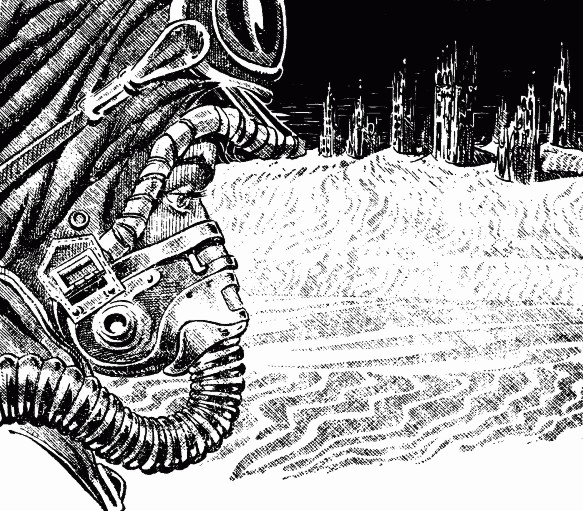
An echo with speculative literature is found in the way that the deciphering of the Antikythera mechanism utilized such details as the number of teeth in the assorted gears (unique ratios identifying which heavenly phenomena are being computed or charted on the dials of the machine) along with such things as historic eclipse patterns (the Saros canon) as important indicators of its meaning and function and aids in reconstruction of the design. This sense of using natural law and natural history as one’s keys to the decipherment, is very much akin to a classic science fiction tale from half a century ago, in which scientists investigating the remains of a disappeared alien race and civilization on their home world (Mars), in attempting to decipher their language — which seemed inherently almost impossible due to lack of a “Rosetta stone&rdquo (like the original that assisted in the decipherment of Ancient Egyptian) — ultimately came to realize that science (natural law), knowledge of which was embedded in the technology and writings of the science-savvy aliens, would serve as their universal Rosetta stone.
That story is “Omnilingual” by H. Beam Piper, 7 first published just fifty years ago, in the February 1957 (1957-02) issue of the extremely influential science fiction magazine then known as Astounding Science Fiction, altered a few years later to the still-extant name of Analog. Astounding/Analog for many years was under the inspired editorship of very well-regarded science fiction author John W. Campbell, Jr. — who has since become even better known as the “father of modern science fiction,” as a result of his tutelage and inspiration of a whole generation and host of talented writers — Heinlein, Asimov, Clarke, van Vogt, Poul Anderson, the list goes on and on…. Piper’s story, I’d venture to suggest, shows every sign of having profited from Campbell’s famous idea generation process vis-a-vis his authors.
(“Omnilingual” is no longer under copyright today, and can be accessed, with its original Kelly Freas illustrations from Astounding and blurb by John Campbell, at Project Gutenberg.)
The story concludes with the archaeologists reveling in having finally begun comprehending the rudiments of the structure of the Martians’ language, using the periodic table of the elements as a starting point — in the course of which Martha Dane compliments one of her colleagues:
“You said we had to find a bilingual,” she said. “You were right, too.”
“This is better than a bilingual, Martha,” Hubert Penrose said. “Physical science expresses universal facts; necessarily it is a universal language. Heretofore archaeologists have dealt only with pre-scientific cultures.”
As we see with the Antikythera mechanism, one need not go to Mars or Alpha Centauri to encounter a scientific culture in archaeology. However, one can’t help but wonder… had any of the scientists who deciphered the Antikythera machine read “Omnilingual,” lo these many years before or at some moment since? Did it influence their work, or even career; did they realize they were retracing the steps, in a sense performing the verification of a scientific hypothesis, which is implicit in the story?
Nature, Vol. 444, No. 7119 (issue date 2006-11-30), Editor's Summary of Antikythera articles: http://www.nature.com/nature/journal/v444/n7119/edsumm/e061130-09.html
1 Jo Marchant, “In search of lost time,” Nature, Vol. 444, Issue No. 7119 (issue dated 2006-11-30), pp. 534-538; doi:10.1038/444534a. See also Box 1: Raised from the depths.
2 T. Freeth, Y. Bitsakis, X. Moussas, J. H. Seiradakis, A. Tselikas, H. Mangou, M. Zafeiropoulou, R. Hadland, D. Bate, A. Ramsey, M. Allen, A. Crawley, P. Hockley, T. Malzbender, D. Gelb, W. Ambrisco, and M. G. Edmunds, “Decoding the ancient Greek astronomical calculator known as the Antikythera Mechanism,” Nature, Vol. 444, Issue No. 7119 (issue dated 2006-11-30), pp. 587-591; doi:10.1038/nature05357. Also, Figures and Tables, Supplementary Information, and Box 1: Astronomical cycles known to the Babylonians.
3 Antikythera Mechanism Research Project: http://antikythera-mechanism.gr/
4 J.V. Field and M.T. Wright (both of The Science Museum, London, SW7 2DD, England), “Gears from the Byzantines: A portable sundial with calendrical gearing,” Annals of Science, Taylor & Francis, Vol. 42, Issue No. 2, issue dated 1985 March (1985-03), pp. 87-138; doi: 10.1080/00033798500200131.
5 Francis Maddison (Curator of the Museum of History and Science, Oxford OX1 3AZ, UK), “Early mathematical wheelwork: Byzantine calendrical gearing,” Nature, Vol. 314, Issue No. 6009 (issue dated 1985-03-28), pp. 316-317; doi: 10.1038/314316b0.
6 François Charette, “High tech from Ancient Greece,” Nature, Vol. 444, Issue No. 7119 (issue dated 2006-11-30), pp. 551-552; doi:10.1038/444551a.
7 H. Beam Piper, “Omnilingual,” Astounding Science Fiction (subsequently Analog), February 1957 (1957-02) issue.
Labels: ancient history, science, science fiction
| (Blank last screen) |
|

![[Powered by Blogger]](http://buttons.blogger.com/bloggerbutton1.gif)
2002-11-03 2002-11-10 2002-11-17 2002-11-24 2002-12-01 2002-12-08 2002-12-15 2002-12-22 2002-12-29 2003-01-05 2003-01-12 2003-01-19 2003-01-26 2003-02-02 2003-02-16 2003-04-20 2003-04-27 2003-05-04 2003-05-11 2003-06-01 2003-06-15 2003-06-22 2003-06-29 2003-07-13 2003-07-20 2003-08-03 2003-08-10 2003-08-24 2003-08-31 2003-09-07 2003-09-28 2003-10-05 2003-10-26 2003-11-02 2003-11-16 2003-11-23 2003-11-30 2003-12-07 2003-12-14 2003-12-21 2003-12-28 2004-01-04 2004-01-11 2004-01-25 2004-02-01 2004-02-08 2004-02-29 2004-03-07 2004-03-14 2004-03-21 2004-03-28 2004-04-04 2004-04-11 2004-04-18 2004-04-25 2004-05-02 2004-05-16 2004-05-23 2004-05-30 2004-06-06 2004-06-13 2004-06-20 2004-07-11 2004-07-18 2004-07-25 2004-08-22 2004-09-05 2004-10-10 2005-06-12 2005-06-19 2005-06-26 2005-07-03 2005-07-10 2005-07-24 2005-08-07 2005-08-21 2005-08-28 2005-09-04 2005-09-11 2005-09-18 2005-10-02 2005-10-09 2005-10-16 2005-10-30 2005-11-06 2005-11-27 2006-04-02 2006-04-09 2006-07-02 2006-07-23 2006-07-30 2007-01-21 2007-02-04 2007-04-22 2007-05-13 2007-06-17 2007-09-09 2007-09-16 2007-09-23 2007-10-07 2007-10-21 2007-11-04 2009-06-28 2009-07-19 2009-08-23 2009-09-06 2009-09-20 2009-12-13 2011-03-27 2012-01-01 2012-02-05 2012-02-12