|
|
Blogroll
|
|
Most recent articles |
|
Highlights |
|
States and Economies |
|
World economies: 15 of 50 largest economies are U.S. States: |
|
World States – Table 1 |
|
History and Society |
|
Fourth of July aboard the W.W. II aircraft carrier the U.S.S. Hornet |
|
A. L. Kroeber's The Civilization of California's Far Northwest |
|
The Arab Admiralty – and an Arab naval view of the Crusades |
|
Excerpt from “The Wife of Bath's Prologue” by Geoffrey Chaucer |
|
“Horsey” Vikings: exploring origin of the “Rohirrim” in The Lord of the Rings
|
|
The Battle of Crécy by Winston S. Churchill |
|
Monotheistic Paganism, or just what was it Christianity fought and faced? |
|
Medieval constipation advice for travelers: “A ripe turd is an unbearable burden” |
|
Alexis de Tocqueville's bicentennial: Anticipatory censorship in colonial America |
|
Antiquity vs. Modernity: Alexis de Tocqueville on the mind of the slaveholder vs. soul of America |
|
Federalism, and Alexis de Tocqueville on the origins of American democracy |
|
Science, Technology, Space |
|
Looking in the right direction – towards the future – with regard to global warming |
|
Know Your Neighborhood: from Andromeda to Fermions and Bosons |
|
Magnetars and Pulsars: Science's special section on pulsars |
|
The Geneva-Copenhagen Survey of Sun-like Stars in the Milky Way |
|
Galactic Central: the Black Hole at the Center of the Galaxy |
|
Politics and War |
|
America’s strong arm, wielding the Sword of Iraq, slays the multi-headed Hydra of Al Qaeda |
|
Regional and Personal |
|
Tamara Lynn Scott |
What wailing wight
Calls the watchman of the night?
William Blake
Whirl is king
Aristophanes
“Jumping into hyperspace ain't like dustin' crops, boy.”
Han Solo, another galaxy
|
Blogroll |
|
Grand Central Station |
|
Legal and Economic |
|
History and Society |
|
Science, Technology, Space |
|
Politics and War |
|
Eclectic |
|
Regional |
|
Reciprocal |
© Copyright 2002 – 2009
Michael Edward McNeil
Impearls: Earthdate 2009-08-29
| Cancer is an evolutionary process |
|
|
F1 Figure 1. Cancer is an evolutionary process. “The lineage of mitotic cell divisions from the fertilized egg to a single cell within a cancer showing the timing of the somatic mutations acquired by the cancer cell and the processes that contribute to them.” Further description of the figure from the Nature article quoted below: “Mutations may be acquired while the cell lineage is phenotypically normal, reflecting both the intrinsic mutations acquired during normal cell division and the effects of exogenous mutagens. During the development of the cancer other processes, for example DNA repair defects, may contribute to the mutational burden. Passenger mutations do not have any effect on the cancer cell, but driver mutations will cause a clonal expansion. Relapse after chemotherapy can be associated with resistance mutations that often predate the initiation of treatment.” |

An illuminating perspective on the nature of cancer has been achieved in that we now realize that cancer is itself the result of a process of biological evolution (random mutation plus natural selection) occurring amongst individual cells within the environment of one's own body.
A technical review article appearing in the renowned scientific journal Nature on the subject of the newly deciphered cancer genome lays out our recent understanding of the nature of cancer: 1
Cancer is an evolutionary process
All cancers are thought to share a common pathogenesis. Each is the outcome of a process of Darwinian evolution occurring among cell populations within the microenvironments provided by the tissues of a multicellular organism. Analogous to Darwinian evolution occurring in the origins of species, cancer development is based on two constituent processes, the continuous acquisition of heritable genetic variation in individual cells by more-or-less random mutation and natural selection acting on the resultant phenotypic diversity.
The selection may weed out cells that have acquired deleterious mutations or it may foster cells carrying alterations that confer the capability to proliferate and survive more effectively than their neighbours. Within an adult human there are probably thousands of minor winners of this ongoing competition, most of which have limited abnormal growth potential and are invisible or manifest as common benign growths such as skin moles.
Occasionally, however, a single cell acquires a sufficiently advantageous set of mutations that allows it to proliferate autonomously, invade tissues and metastasize.
Some people reject this concept, at least on first encounter, believing it to be, as one person put it, ”a misapplication of evolutionary theory,” because “cancerous changes in cells insure their own destruction rather than being passed on to the next [human] generation,” and “thus cancer is better understood as a malfunction [or degeneration] of cellular mechanisms rather than an evolutionary process.”
This argument is wrong, or at best an appreciation of only half of the dual interacting principles that are at work in the onset of cancer. In this regard, one might note that the authors of the foregoing Nature piece from which the earliest quotation was excerpted are highly experienced cancer researchers and thus hardly naive concerning this topic. Beyond that mere “argument from authority,” however, though genetic “malfunctions” (aka mutation) do of course occur, the development of cancer goes way beyond a mere haphazard accumulation of defects — which would indeed be inherently far less dangerous — rather, the creation of cancer is propelled by true evolutionary forces.
The typically negative changes that the bulk of accidental genetic modifications to complex biological systems (known as mutations) introduce, subsequently get filtered in living environments by natural selection (random mutations in combination with natural selection being collectively known evolution), leaving only the advantageous (or at least neutral) results behind — advantageous, that is (in the context we're discussing), for individual cell lineages, if not for the body as a whole — which steadily improves the cells of those lineages' reproductive and competitive standing within the body's increasingly diverse cellular environment.
Beyond that, however, taking the above objection at face value would mean that whenever a new species evolves/arises out of another to fit the environment in which it presently finds itself (for instance, humans with their big brains evolving during the last few million years out of stupider hominids) — but which evolutionary alterations happen to ensure that the environment afterwards changes or even is disrupted or destroyed by the actions of the newer species (such as people blowing up the world or making it unfit to live in due to pollution or global warming) so that the species subsequently becomes extinct — that the earlier adaptive changes resulting in the origin of that species would therefore have to be deemed not to have been “evolution”! Good to know; Creationists must therefore be right: humans didn't evolve! (End sarcasm.)
Discarding sarcasm, it's important to realize that body cells which are progressing towards a cancerous variety as a result of the dual actions of mutation and natural selection (i.e., evolution) are “fitter” — in that those cells successfully out-reproduce and out-compete for a considerable length of time their more unassuming compatriots within the bodily environment. It's not till much later (cellular time-wise) that the overall encompassing bodily environment could end up being destroyed as a consequence of the tumor that those cells may eventually grow into. In the meantime, those cells are responding to real evolutionary forces that propel their progression — not mere haphazard “degeneration.”
It can even occur on occasion that a cancerous line does not get wiped out along with its host! As it happens there is a variety of cancer in dogs known as canine transmissible venereal tumor (CTVT), also called Sticker's sarcoma (that one can learn about here 2), which, rather than being viral in nature as most infectious cancers are, actually consists of the mutated cells of the original dog that initially developed that variety of cancer, in the course of which somehow evolving the capability to survive and escape from its host, infecting other dogs thereafter in an endless chain, and thus as a result long outliving its original progenitor.
Ignoring the instance of the cancerous dog cell lineage that succeeded in escaping and outliving its bodily host whilst infecting dogs more generally — even more “ordinary” cancers that never manage to escape and live free of their host are remarkable as instances of the body's constituent cells (or rebel lineages of them) learning via evolution how to disobey the body's regulatory apparatus — in effect raising the “jolly roger,” taking up a life of independent piracy within the host, perhaps in the end by their free-wheeling activities killing off their formerly allied-to body.
A page at the University of California, Berkeley, titled “ Another perspective on cancer: Evolution within,“ puts the ultimate evolutionary origin of cancers succinctly: 3
[D]espite increased attention and funding, the cure for this and other cancers has remained notoriously elusive. Viewing cancer through the lens of evolution helps explain why a cure seems to remain just out of reach and points the way toward new treatments. Where's the evolution? Iconic examples of evolution (birds evolving from dinosaurs, hominids evolving an upright posture, or a lineage of lobe-finned fish evolving four legs and moving onto land) might seem unrelated to the growth of a cancerous tumor, but the process underlying them both — natural selection — is identical. We typically think of natural selection acting among individuals, favoring those carrying advantageous traits and making those traits more common in the next generation. However, the key elements of this process — variation, inheritance, and selective advantage — characterize not just populations of organisms in a particular environment, but also populations of cells within our own bodies. The cells lining your intestines, for example, are not genetically uniform; there is variation among them. Some of those cells have incurred chance mutations as they have divided. If one of those mutations (or a series of mutations) allows its bearer to evade cell death and reproduce more prolifically than others, it will pass that mutation on to its daughter cells, and cells bearing that mutation will increase in frequency over time. Like organisms in an ecosystem, cell lineages within one's own body compete for resources. A cell lineage that gains an advantage in that competition, accumulating mutations that allow it to grab extra resources and escape the body's control mechanisms, will proliferate and may evolve into a cancerous tumor.
One is reminded of renowned science fiction writer (as well as editor) John W. Campbell's chilling tale from 1938, “Who Goes There?” (subsequently made into the 1951 motion picture The Thing from Another World, remade as The Thing in 1982) in which a terrible alien menace, liberated from Antarctic ice, possessed (once unfrozen) the capability of taking over the substance of animal and man, incorporating it into its own flesh and being — whilst (contrary to eating and ingestion as we know it) continuing to present the devoured human or animal's semblance as a “doppelganger” or zombie of that individual. Thus, an entire kennel of dogs or barracks of humans could, in the context of that story, be surreptitiously consumed one by one and thereby incorporated into the newly revived alien life form.
The thing (pun intended) that saved the folk in that story was that every such subsumed (semblance of a) human or animal, though now fully part of the alien species, was ultimately still an individual that would fight for its own survival when threatened — and simply separating a small part (such as a bit of sampled blood) of the creature whenever its takeover of man or dog was suspected, and then “threatening” that sample (with a hot wire perhaps), would cause the newly separated being to recoil in its own defense (unlike untransformed people's blood), thus revealing the doppelganger.
As a character in story put it, initially blurting out the idea: 4
“Blood is tissue. They have to bleed; if they don't bleed when cut, then by Heaven, they're phoney from hell! If they bleed — then that blood, separated from them, is an individual — a newly formed individual in its own right, just as they — split, all of them, from one original — are individuals!”
“Get it, Van? See the answer, Bar?”
Van Hall laughed very softly. “The blood — the blood will not obey. It's a new individual, with all the desire to protect its own life that the original — the main mass from which it was split — has. The blood will live — and try to crawl away from a hot needle, say!”
It's extremely interesting, I think, that our own body cells turn out to be rather like Campbell's hypothetical alien menace, as they evolve on their own as individuals within one's own body toward an independent, if piratical, existence.
Realizing that cancer results from an evolutionary progression amongst the cells within one's own body provides an illuminating perspective with regard to the fundamental nature of cancer, revealing just why it is that cancer so often proves resistant to treatment (as cancerous cells simply evolve away from a given regimen unless every last tumor-generating cell is thereby destroyed), as well as suggesting a number of avenues along which the phenomenon may be mitigated, obviated, and (one hopes) ultimately defeated.
F1 Figure 1 from the Ref. 1 Nature article.
1 Michael R. Stratton, Peter J. Campbell, P. Andrew Futreal, “The Cancer Genome,” Nature, Vol. 458, Issue no. 7239 (9 April 2009 [2009-04-09]), pp. 719-724.
2 Carl Zimmer, “A Dead Dog Lives On (Inside New Dogs),“ The Loom, August 9, 2006 [2006-08-09].
3 “Another perspective on cancer: Evolution within,” October 2007 [2007-10], part of: “Understanding Evolution,” University of California, Berkeley.
4
John W. Campbell (under the pseudonym Don A. Stuart), “Who Goes There?”, August 1938 [1938-08], Astounding Science Fiction, Street & Smith Publications, Inc., New York.
Collected in: The Best of John W. Campbell, Edited with an introduction by Lester Del Rey, Nelson Doubleday, Inc., Garden City, New York, 1976, pp. 246-298; quote on p. 291.
Also collected in: John W. Campbell, Who Goes There?, Shasta Publishers, 1948.
Made into the motion picture The Thing from Another World, directed by Howard Hawks, Winchester Pictures, distributed by RKO Radio Pictures, 1951.
Remade as The Thing, directed by John Carpenter, distributed by MCA / Universal Pictures, 1982.
Labels: cancer, evolution, John W. Campbell, science fiction
Impearls: Earthdate 2007-06-18
| No mere Bipeds, but Biplanes! |
|
Glenn Reynolds the Instapundit recently pointed to an MSNBC news report detailing the $25 million “Creation Museum” that has commenced operations near Petersburg in rural Kentucky, just across the Ohio from Cincinnati; in which it is presented with an apparently straight face that dinosaurs and humans once lived simultaneously and cozily with each other, but the former apparently had bad PR with God and got wiped out in the (mythical) Flood — no Ark for them — despite it being humans that ate the apple! (Yes, I know I’m mixing up two distinct mythological tales, but that doesn’t change the point: it wasn’t dinosaurs that committed the evil deeds that supposedly led God to despair and decide to wipe out his chosen species — Man.)
It’s amusing reading of the psychic antics of Creationists — fondly imagining that humans ever contemporaneously interacted with dinosaurs — while exhibiting so little comprehension of the concept and phenomenon of the “geologic column,” which concretely reveals that the two kinds (and so much else) were kept absolutely, totally, and universally distinct from one another. (The scientific explanation for that observable absolute separation is that vast gulfs of time kept them apart — resulting in humans’ and dinosaurs’ (et al.) respective remains appearing in totally different geological strata — but, of course, “Young Earth” Creationists reject a priori the existence of great gulfs of time: to them the Earth, indeed the entire cosmic universe, is and must be no more than about 6,000 years old.)
Creationists struggle to keep their image of dinosaurs up to date in the latest scaly form — unfortunately for them, as we shall see, the dinosaurs as they are portrayed in their spanking new Creation Museum are already obsolete — whilst everything, in their view, dinosaurs and all the rest, must be somehow shoehorned to fit into a straightjacket frame that was fixed onto stone tablets by wandering desert tribesfolk some three millennia ago.
 Meanwhile, science keeps marching on.
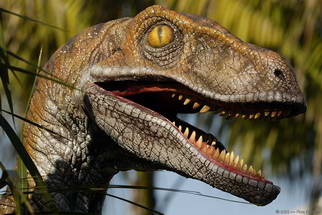
During the brief decade and a half since our mental image of Velociraptors (as well as Tyrannosaurus) was illuminated and vividly fixed in our minds by Steven Spielberg’s dramatic film Jurassic Park, the general scientific picture of these and related clans of dinosaurs has been revolutionized and transformed away from that sharp image.
Meanwhile, science keeps marching on.
During the brief decade and a half since our mental image of Velociraptors (as well as Tyrannosaurus) was illuminated and vividly fixed in our minds by Steven Spielberg’s dramatic film Jurassic Park, the general scientific picture of these and related clans of dinosaurs has been revolutionized and transformed away from that sharp image.
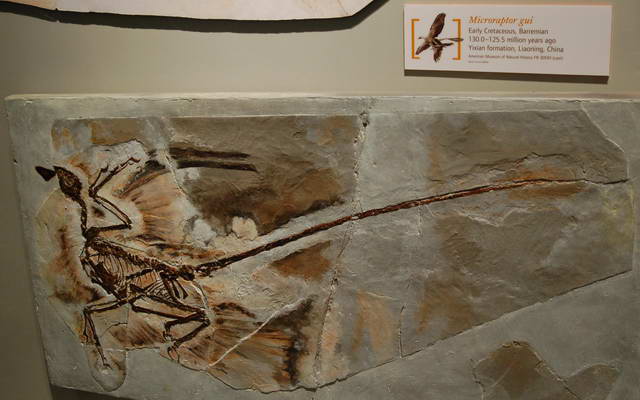
Not that those carnivorous dinosaurs weren’t active and vigorous, mind you, as well as very likely warm-blooded. I’ve been following this issue ever since an article in the journal Science during the late 1990’s reported discovery of a series of extremely well-preserved dinosaur fossils from Liaoning province in northeastern China, carrying such exquisite detail as a result of fine volcanic ash deposits that clear impressions of the mantling of feathers are readily apparent. These fossil dinosaurs turn out to be close relatives and ancestors of Velociraptors and Tyrannosaurus and other (saurischian) theropod dinosaurs, as well as being relatives (“cousins”) to the true birds we know and love today.
Just as in human evolution we’ve learned that the original, simplest, Ockham’s razor-like hypothesis, though seemingly plausible — that the rise to bipedal stance was connected with the freeing up of the hands for the use of tools, and thus higher human intelligence — turned out in fact to be too simple. We now know that “Lucy” and the other Australopithecines walked erect whilst in possession of brains no bigger than those of chimpanzees — thus the evolution of bipedalism had to be both earlier and independent of toolmaking and the rise of higher-than-animal intelligence. Similarly, in dinosaur-bird evolution it had been simplistically assumed that the evolution of feathers was directly connected with that of flight as well as of birds themselves. The light but strong aerodynamic shapes and surfaces presented by flight-feathers in living birds today made that assumption seem somewhat natural.
 Now we’ve discovered that those two things — feathers and flight — also arose independently and disjointedly in time. *
It appears, indeed, that feathers initially possessed no flight functionality at all, but were adapted by certain lines of theropod dinosaurs for insulation purposes — indicating thereby that they likely were, as has been hypothesized, warm blooded.
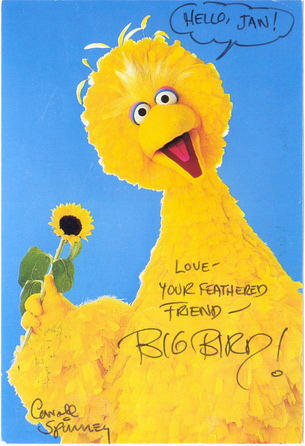
As a result, some families of dinosaurs, contrary to their conventionally presented (e.g., Jurassic Park) scaly appearance, probably evoked a certain (albeit pointy-toothed and slashing-clawed) “Big Bird” aspect, covered with downy feathers (whether yellow or not) like a bird chick as they likely were.
Now we’ve discovered that those two things — feathers and flight — also arose independently and disjointedly in time. *
It appears, indeed, that feathers initially possessed no flight functionality at all, but were adapted by certain lines of theropod dinosaurs for insulation purposes — indicating thereby that they likely were, as has been hypothesized, warm blooded.
As a result, some families of dinosaurs, contrary to their conventionally presented (e.g., Jurassic Park) scaly appearance, probably evoked a certain (albeit pointy-toothed and slashing-clawed) “Big Bird” aspect, covered with downy feathers (whether yellow or not) like a bird chick as they likely were.
(*This principle, that different parts and organs of evolving organisms may evolve at differing rates or sequentially, rather than steadily, all together over time — a phenomenon known as “mosaic evolution” — seems obvious to me, but appears surprising to some otherwise esteemed evolutionary theorists.)
Beyond that, in certain theropod dinosaur lineages descendant from those initially inventing them, feathers evolved beyond mere insulating down into “pennaceous feathers” (i.e., feathers having a “central shaft with vanes branching off to either side,” as Wikipedia describes them). Recent data indicates that Velociraptors, though obviously flightless, likely possessed such pennaceous feathers — whose evolution, like that of downy feathers, also apparently occurred for reasons independent of flight. (Whatever those reasons were would seem to be unknown at present.)
Furthermore, it now appears that flight itself initially evolved
before, and thus independently of, birds.
Fossil evidence from several lines of dinosaurs — near relatives of birds but apparently outside the lines leading to true birds and the direct ancestors thereto — shows that all kinds of living experiments were being conducted, involving some experimental “craft” that were not only gliders but likely also flew, perhaps as well as the famous Archaeopteryx (thought to be close to the line leading to birds).
Take a close look at this image (from Wikipedia):

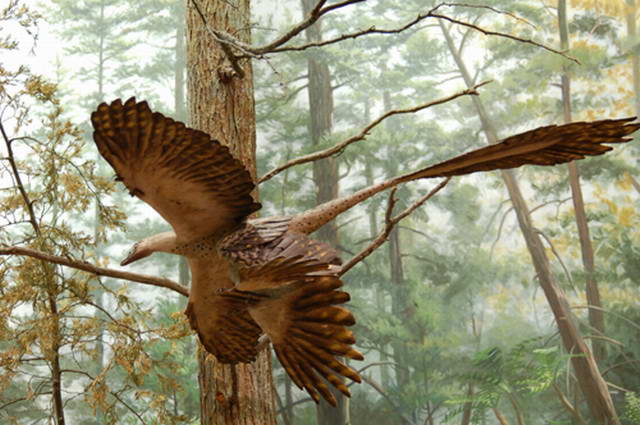
Look at it — and then look again. You’re not going cross-eyed; the picture reveals a small theropod dinosaur called Microraptor (see the Wikipedia article of that name), a type of Dromaeosaur (as was Velociraptor), which had wings (flight feathers extending out on either side) on its feet, as well as more conventional wings on its arms. In other words, Microraptor was not a biped (or not just a biped), but a biplane!
It’s extremely interesting that the advent of flight in animals — at least the form leading to flight in birds, via theropod dinosaurs (obviously pterosaurs, as a line of reptiles distant from dinosaurs, and bats as mammals, may well have followed different technological pathways) — should have paralleled the trajectory which for us led to human flight: Both technological evolutionary advances involved experimenting with varieties of “airplane” utilizing two parallel rows (planes) of wings, one above the other — after which (or as an alternative approach to which) in the line leading to true birds the overall design was revamped and streamlined by abandoning the lower bank of wings in lieu of a simplified set of landing gear (doubling as weapons: talons on raptor birds). Teeth were ultimately eliminated in lieu of the (lighter) beak, claws on the (front) wings were also discarded — while, once again, these events occurred sequentially one after another and at a discontinuous rate through time.
Note that Microraptor is a very, very close, though diminutive, relative of Velociraptor. Take a look at the relationship tree connecting the two genera (which you can review in the Wikipedia article on “Feathered Dinosaurs”) for insights into how closely related they really were.
As paleontologist Mark Norell of the American Museum of Natural History (AMNH) in New York City, put it (in an article in Science, the one first cuing me in on this subject, the better part of a decade ago): 1 “We have as much evidence that Velociraptors had feathers as we do that Neandertals had hair”!
That impression has only greatly strengthened over the intervening years as more and more new, dramatically feathered dinosaur fossils have been discovered.
UPDATE: 2007-07-10 17:10 UT: Changed image hosting facility and re-hosted images after former site reported itself as being hacked and didn’t recover after a few days.
UPDATE:
2007-10-31 19:00 UT:
Changed image hosting facility again (to Flikr this time) after next host went down and stayed down for a few days.
1 Tim Appenzeller, “T. rex Was Fierce, Yes, But Feathered, Too,” Science, Vol. 285, Issue 5436 (Earthdate 1999-09-24), pp. 2052-2053; [DOI: 10.1126/science.285.5436.2052].
Labels: birds, creationism, dinosaurs, evolution
Impearls: Earthdate 2004-04-19
| Scientific Laws and Theories |
Reader Mike Zorn writes in reply to
“Query: Why then bother to examine alternative theories of gravity?
Reply: To have foils against which to test Einstein's theory.”Exactly. That's what makes a theory: it has to be capable of being disproved.
I think that one of the problems the public has with science is that the public's definition of “theory” is completely different from the scientist's. […] [T]he public [has a] perception of “theory” as “a really good guess,” vs. science's definition as “the best explanation we have so far that fits all the facts we have so far.” (As in, “evolution? It's just a theory — why should we pay so much attention to it?”)
Mike makes good points here. Many people think of science as little more than a gathering or encyclopedia of facts and, as Zorn notes, there's a perception that a scientific “theory” is merely a vague hypothesis or guess, as good (or bad) as any other.
These common perceptions are actually quite far from science.
Looking back on the requirements for a “viable” theory of gravity as described in the previous posting (see the link above), it should now be clear that a good theory is vastly more robust than than a mere guess.
It must be internally self-consistent, incorporate
As Mike says, it must be
Nor does evolution in particular belong on a qualitatively different and lower plane than, say, physics.
The fact that evolution to an extent draws its information from out of the distant past is not important in this regard.
Geology and astronomy similarly derive much of their data from the far past, yet these are quite decidedly “true,” reliable sciences.
Every fossil dug up out of the ground is a newly-detected signal from the past, readily able to disprove evolution if new results show that the painfully built up pattern of relationships within the organisms of the past is but an illusion.
(I'll not hold me breath waiting for that to happen!)
Every science, in fact, deals with (and
Physicist and philosopher of science Jacob Bronowski put it this way, in his book
We are not merely observing and predicting facts; and that is why any philosophy which builds up science only from facts is mistaken. We know, that is we find laws, and every human action uses these laws, and at the same time tests them and feels towards new laws. It is not the form of these laws which matters. The laws of science, like those which we use in our private behaviour, remain helpful and truthful whether they contain words like “always,” or only “more often than not.” What matters is the recognition of the law in the facts. It is the law which we verify: the pattern, the order, the structure of events. This is why science is so full of the symbolism of numbers and geometry, which are the most familiar expressions of structural relations.
There is no sense at all in which science can be called a mere description of facts. It is in no sense, as humanists sometimes pretend, a neutral record of what happens in an endless mechanical encyclopaedia. This mistaken view goes back to the eighteenth century. It pictures scientists as utilitarians still crying
Let be! and still believing that the world runs best with no other regulating principles than natural gravitation and human self-interest.But this picture of the world of Mandeville and Bentham and Dickens's
Hard Times was never science. For science is not the blank record of facts, but the search for order within the facts. And the truth of science is not truth to fact, which can never be more than approximate, but the truth of the laws which we see within the facts. And this kind of truth is as difficult and as human as the sense of truth in a painting which is not a photograph, or the feeling of emotional truth in a movement in music. When we speak of truth, we make a judgment between what matters and what does not, and we feel the unity of its different parts. We do this as much in science as in the arts or in daily life.We make a judgment when we prefer one theory to another even in science, since there is always an endless number of theories which can account for all the known facts. And the principles of this judgment have some deep appeal which is more than merely factual. William of Ockham first suggested to scientists that they should prefer that theory which uses in its explanation the smallest number of unknown agents. Science has held to this principle now for six hundred years. But is there indeed any ground for it other than a kind of aesthetic satisfaction, much like that of sacrificing your queen at chess in order to mate with a knight?
We cannot define truth in science until we move from fact to law. And within the body of laws in turn, what impresses us as truth is the orderly coherence of the pieces. They fit together like the characters in a great novel, or like the words in a poem. Indeed, we should keep that last analogy by us always. For science is a language, and like a language, it defines its parts by the way they make up a meaning. Every word in the sentence has some uncertainty of definition, and yet the sentence defines its own meaning and that of its words conclusively.
It is the internal unity and coherence of science which gives it truth, and which makes it a better system of prediction than any less orderly language.
1
J. Bronowski,
UPDATE: 2004-04-29 23:50 UT: A follow-up “Copernicus Dethroned” has been posted.
Labels: evolution, general relativity, gravity, Jacob Bronowski, philosophy of science, physics science, scientific theories
| (Blank last screen) |
|

![[Powered by Blogger]](http://buttons.blogger.com/bloggerbutton1.gif)
2002-11-03 2002-11-10 2002-11-17 2002-11-24 2002-12-01 2002-12-08 2002-12-15 2002-12-22 2002-12-29 2003-01-05 2003-01-12 2003-01-19 2003-01-26 2003-02-02 2003-02-16 2003-04-20 2003-04-27 2003-05-04 2003-05-11 2003-06-01 2003-06-15 2003-06-22 2003-06-29 2003-07-13 2003-07-20 2003-08-03 2003-08-10 2003-08-24 2003-08-31 2003-09-07 2003-09-28 2003-10-05 2003-10-26 2003-11-02 2003-11-16 2003-11-23 2003-11-30 2003-12-07 2003-12-14 2003-12-21 2003-12-28 2004-01-04 2004-01-11 2004-01-25 2004-02-01 2004-02-08 2004-02-29 2004-03-07 2004-03-14 2004-03-21 2004-03-28 2004-04-04 2004-04-11 2004-04-18 2004-04-25 2004-05-02 2004-05-16 2004-05-23 2004-05-30 2004-06-06 2004-06-13 2004-06-20 2004-07-11 2004-07-18 2004-07-25 2004-08-22 2004-09-05 2004-10-10 2005-06-12 2005-06-19 2005-06-26 2005-07-03 2005-07-10 2005-07-24 2005-08-07 2005-08-21 2005-08-28 2005-09-04 2005-09-11 2005-09-18 2005-10-02 2005-10-09 2005-10-16 2005-10-30 2005-11-06 2005-11-27 2006-04-02 2006-04-09 2006-07-02 2006-07-23 2006-07-30 2007-01-21 2007-02-04 2007-04-22 2007-05-13 2007-06-17 2007-09-09 2007-09-16 2007-09-23 2007-10-07 2007-10-21 2007-11-04 2009-06-28 2009-07-19 2009-08-23 2009-09-06 2009-09-20 2009-12-13 2011-03-27 2012-01-01 2012-02-05 2012-02-12