|
|
Blogroll
|
|
Most recent articles |
|
Highlights |
|
States and Economies |
|
World economies: 15 of 50 largest economies are U.S. States: |
|
World States – Table 1 |
|
History and Society |
|
Fourth of July aboard the W.W. II aircraft carrier the U.S.S. Hornet |
|
A. L. Kroeber's The Civilization of California's Far Northwest |
|
The Arab Admiralty – and an Arab naval view of the Crusades |
|
Excerpt from “The Wife of Bath's Prologue” by Geoffrey Chaucer |
|
“Horsey” Vikings: exploring origin of the “Rohirrim” in The Lord of the Rings
|
|
The Battle of Crécy by Winston S. Churchill |
|
Monotheistic Paganism, or just what was it Christianity fought and faced? |
|
Medieval constipation advice for travelers: “A ripe turd is an unbearable burden” |
|
Alexis de Tocqueville's bicentennial: Anticipatory censorship in colonial America |
|
Antiquity vs. Modernity: Alexis de Tocqueville on the mind of the slaveholder vs. soul of America |
|
Federalism, and Alexis de Tocqueville on the origins of American democracy |
|
Science, Technology, Space |
|
Looking in the right direction – towards the future – with regard to global warming |
|
Know Your Neighborhood: from Andromeda to Fermions and Bosons |
|
Magnetars and Pulsars: Science's special section on pulsars |
|
The Geneva-Copenhagen Survey of Sun-like Stars in the Milky Way |
|
Galactic Central: the Black Hole at the Center of the Galaxy |
|
Politics and War |
|
America’s strong arm, wielding the Sword of Iraq, slays the multi-headed Hydra of Al Qaeda |
|
Regional and Personal |
|
Tamara Lynn Scott |
What wailing wight
Calls the watchman of the night?
William Blake
Whirl is king
Aristophanes
“Jumping into hyperspace ain't like dustin' crops, boy.”
Han Solo, another galaxy
|
Blogroll |
|
Grand Central Station |
|
Legal and Economic |
|
History and Society |
|
Science, Technology, Space |
|
Politics and War |
|
Eclectic |
|
Regional |
|
Reciprocal |
© Copyright 2002 – 2009
Michael Edward McNeil
Impearls: Earthdate 2009-12-15
| George Washington – Apotheosis of Character |
|
|
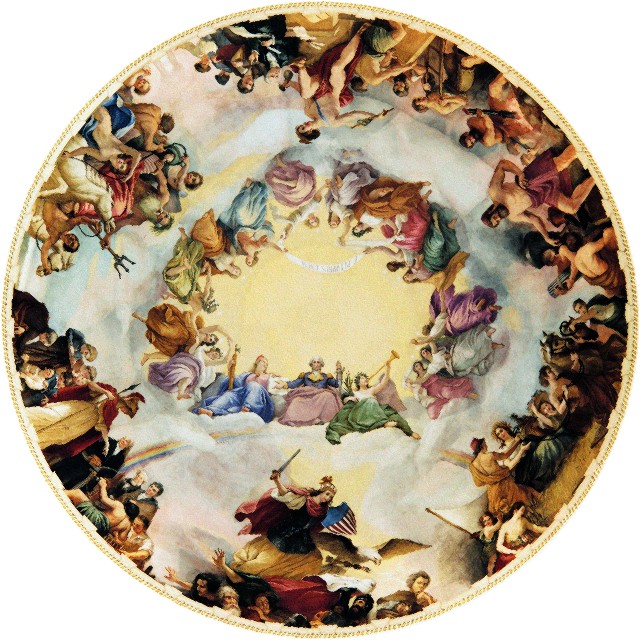
Enthroned above a rainbow (in Constantino Brumidi's stunning masterpiece “The Apotheosis of Washington”), the deified George Washington — first President of the United States and acclaimed as “father of his country” — regards us from on high as the Lord of Hosts and Supreme Judge of the Universe. With a gesture at the Law/Constitution on the one hand, upraising a downturned sword with the other — flanked by the goddesses of Liberty (grasping the traditional Roman fasces of authority) and Victory/Fame (cradling a palm of victory whilst flourishing the clarion of fame) — the apotheosized Washington sits haloed by a constellation of thirteen Starry maidens, hoisting a banner proclaiming E Pluribus Unum.
Round about that scene (starting at bottom, thence proceeding clockwise) are depicted tableaus of
War,
Science,
“Marine,”
Commerce,
Mechanics,
and
Agriculture — occupying the crown of the great dome arching above the Capitol, within whose hallowed halls the Congress of the United States sits and holds session.
|
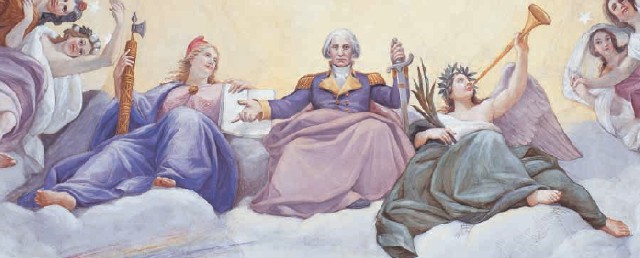
This year (2009) marks the 210th anniversary of the passing (on earthdate 1799-12-15) of the man who, first as a general in war, won the freedom of the people of the United States of America; thereafter in peace (after the ignominious failure of the first American constitution, the Articles of Confederation) presided by acclamation over the Constitutional Convention, which — composed of all-time exceptionally clear-headed political thinkers — drafted the Constitution of the United States, still in effect today (a monumental accomplishment compared with the experience of almost every other country in the world); finally serving two terms as the first constitutional President of the unified American nation. Beyond those stupendous achievements was his final voluntary withdrawal after those elected terms of office, retiring to his Mount Vernon estate and removing himself entirely from subsequent politics — which, one might judge, due to the outstanding example presented to his successors and to posterity, as equal to all the preceding actions of his eventful career. These acts made Washington the stuff of legend — an almost deliberate hearkening back to Republican Rome in its grandeur.
Nowadays, following the turn of the 21st century, the extraordinary devoted homage earlier eras in America paid to its founding General and President seems more than a bit mysterious. Portrayals of Washington in powdered wig and the 18th century elite attire of the day present a notably quaint appearance today, and though founder of the U.S.A. (which somehow in retrospect seems a very easy thing to do, even foreordained), really — so the “modern,” irreverent trendy line of thought goes — what did he do that was so all-fired great? Folk today typically know little of the period or the man, so nothing (or very little) is usually the implied answer — and since most folks' dilettantish inquiries seldom go further, that's usually the end of their investigation.
However, after ten score and ten years it's high time in my view for people to once again begin to reacquaint themselves with the great man and the impact, the effect the sheer force of his character has had, on America and indeed the history of the world.
Labels: Allan Nevins, American history, ancient Rome, apotheosis, constitution, George Washington, Hendrik Willem van Loon, Revolutionary War, United States of America, William of Orange (the Silent)
| Introduction |
Most people forget the role Washington performed between the war (the Revolutionary War, where he played a decisive part in obtaining the victory), and his two terms as first President of the United States. Historian Allan Nevins wrote about that seeming hiatus, especially with regard to Washington's commanding presence as presiding officer at the Constitutional Convention, full of portent for the future: 1
Viewing the chaotic political condition of the United States after 1783 with frank pessimism and declaring (May 18, 1786) that “something must be done, or the fabric must fall, for it is certainly tottering,” Washington repeatedly wrote his friends urging steps toward “an indissoluble union.” At first he believed that the Articles of Confederation might be amended. Later, especially after the shock of Shays's rebellion, he took the view that a more radical reform was necessary but doubted as late as the end of 1786 that the time was ripe. His progress toward adoption of the idea of a federal convention was, in fact, puzzlingly slow. Though John Jay assured him in March 1786 that breakup of the nation seemed near and opinion for the convention was crystallizing, Washington remained noncommittal. But despite long hesitations, he earnestly supported the proposal for a federal impost, warning the states that their policy must decide “whether the Revolution must ultimately be considered a blessing or a curse.” And his numerous letters to the leading men of the country assisted greatly to form a sentiment favourable to a more perfect union. Some understanding being necessary between Virginia and Maryland regarding the navigation of the Potomac, commissioners from the two states met at Mount Vernon in the spring of 1785; from this seed sprang the federal convention. Washington approved in advance the call for a gathering of all the states to meet in Philadelphia in May 1787 to “render the Constitution of the Federal Government adequate to the exigencies of the Union.” But he was again hesitant about attending, partly because he felt tired and infirm, partly because of doubts about the outcome. Although he hoped to the last to be excused, he was chosen one of Virginia's five delegates.
Washington arrived in Philadelphia on May 13, the day before the opening of the Convention, and as soon as a quorum was obtained he was unanimously chosen its president. For four months he presided over the Constitutional Convention, breaking his silence only once upon a minor question of congressional apportionment. Though he said little in debate, no one did more outside the hall to insist on stern measures. “My wish is,” he wrote, “that the convention may adopt no temporizing expedients, but probe the defects of the Constitution to the bottom, and provide a radical cure.” His weight of character did more than any other single force to bring the convention to an agreement and obtain ratification of the instrument afterward. He did not believe it perfect, though his precise criticisms of it are unknown. But his support gave it victory in Virginia, where he sent copies to Patrick Henry and other leaders with a hint that the alternative to adoption was anarchy, declaring that “it or dis-union is before us to chuse from,” told powerfully in Massachusetts. He received and personally circulated copies of The Federalist. When ratification was obtained, he wrote to leaders in the various states urging that men staunchly favourable to it be elected to Congress. For a time he sincerely believed that, the new framework completed, he would be allowed to retire again to privacy. But all eyes immediately turned to him for the first president. He alone commanded the respect of both the parties engendered by the struggle over ratification, and he alone would be able to give prestige to the republic throughout Europe. In no state was any other name considered. The electors chosen in the first days of 1789 cast a unanimous vote for him, and reluctantly — for his love of peace, his distrust of his own abilities, and his fear that his motives in advocating the new government might be misconstrued all made him unwilling — he accepted.
We will essay to explore further what is already apparent from Nevins's exposition of Washington: the critical importance for the history of American and the world of character.
For insight in this regard, let's turn to that delightful collection of fantasy dinner conversations with great personages of history Van Loon's Lives, published 1942 — prepared for the edification and inspiration of his grandchildren by Dutch-American historian and journalist Hendrik Willem van Loon, who arrived on America's shores in 1903 at the tender age of 19.
In the foreword to his imaginary dinner with both William of Orange (known as the Silent; founder of the 16th-century Dutch Republic, whose declaration of independence from the Habsburg Spanish Empire, the Act of Abjuration, left reverberations echoing down through history to our own Declaration of Independence), as well as George Washington (father some two centuries after William of America's Republic), van Loon ended his introduction to Washington's life (which we'll soon consider in detail) with the following penetrating comment: 2
[I]t was he who founded our republic; it was this Virginian planter who set us free from foreign domination; it was this Southern aristocrat who started us off on our noble experiment in self-government, and he was able to do this because he was far ahead of his contemporaries in that one particular respect which counts more heavily in the scales of the gods than all other qualifications for glory and success put together.
George Washington was the embodiment of character.
Webster defines character as follows: ”Highly developed or strongly marked moral qualities; individuality, esp. as distinguished by moral excellence; moral vigor or firmness, esp. as acquired through self-discipline; inhibitory control of one's instinctive impulses….”
I think that I can let it go at that. For my final comment upon both William of Orange and George Washington need consist of but one single word: CHARACTER.
We've already pointed to Washington's critical role in the drafting and ratification of the Constitution, which may also be attributed to the force of his character on the Convention and country. But there is another aspect in which Washington's character had a terrific impact on the future of the fledgling nation, and that is the manner in which he departed the office of Presidency.
One should observe that in all the centuries-long history of the Roman Empire (so analogous to America in certain ways, but in this respect so totally different) there was only a single emperor — to wit, Diocletian (regnant 284-305 a.d.) — who managed at the end of his reign to retire and devote the remainder of his days to gardening. * All other emperors of the Empire either died in office or were bloodily overthrown.
(*Diocletian's retirement palace — one can see an illustration of what it looked like here — over time transformed into the ancient historical core of the modern Adriatic coastal city of Split in Croatia.)
Washington retired from office after only two terms, less than a decade. He could have run again, but chose not to, setting a lasting, shining example for future American Presidents — whose tradition continued unbroken until, with World War II raging abroad, Franklin Roosevelt chose to stand for a third, and then a fourth term. (After the war, a constitutional amendment enforcing a two-term limit was ratified.)
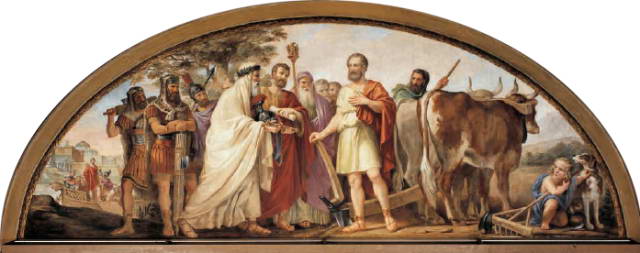
Washington and the Founders went even further in emphasizing a specifically Roman counterexample in an attempt to offset any tendency toward military instability such as Roman history so well exemplified, by creating an official association of Revolutionary War officers — the Society of Cincinnati — explicitly inspired by the Roman citizen-farmer Lucius Quinctius Cincinnatus (born circa 519 b.c.), who became Roman Consul and then (emergency) Dictator, but after the foe was vanquished, retired once again to his farm.
Washington and subsequent Presidents' example was such a success that nothing like a military rebellion has ever occurred in U.S. history.
And still, even today, America continues to transition authority wholly peacefully from one President to the next — in what is really a revolution: every election in a democracy is a revolution — an entirely peaceful revolution — yet one so many people in this country blithely take wholly for granted.
For me, though, given the stark precedents from Roman history, whenever I see each peaceful transfer of power occur, I consider it almost a miracle.
|
Labels: Allan Nevins, American history, ancient Rome, apotheosis, constitution, George Washington, Hendrik Willem van Loon, Revolutionary War, United States of America, William of Orange (the Silent)
Impearls: Earthdate 2009-09-06
| Sex in Antiquity III – the Wages of Adultery |
|
I've been watching the first couple seasons of the BBC series Rome, checked out from the library. Covering the period of Caesar and Octavian, it's pretty entertaining, especially considering the various antics and tribulations that Vorenus and Pullo, two non-historical characters whose supposed lives we follow through the history, get into (I won't spoil it for folks by detailing them).
Rome as a production does appear to go to some effort trying to get its portrait of classical history and civilization basically correct, but can be seen to fail on occasion. I was amused by a scene in season two where a high-status woman who is having an affair with a man is quite offended when he attempts to offer her money, rejecting it as portraying her as a prostitute — which it turns out is quite ahistoric, merely projecting modern attitudes onto a very different antique society.
As Paul Veyne writes in his chapter “The Roman Empire” in Volume I of A History of Private Life: 1
The social and institutional character of the Roman economy was so different from that of our own that it is tempting to call it archaic. It sustained, nevertheless, a high level of production and was as dynamic and ruthless as capitalism. For, if Roman aristocrats distinguished themselves by their culture and their interest in philosophy, they were still avid for profit.
The greatest nobles talked business. Pliny, a senator, in letters intended to be specimens of the finest in the genre, held up his behavior as a wealthy landlord as an example for others to follow. When a noble wished to get rid of old furniture or building materials, he held a public auction. (Auctions were the normal way for private individuals to sell their used belongings; the emperors themselves auctioned off unwanted palace furniture.)
Money was not supposed to lie idle. Even loans to friends and relatives earned interest (not charging interest on such loans was considered a mark of special virtue). A woman's father had to pay interest to her husband if transfer of her dowry was delayed.
Usury was a part of daily life; modern anti-Semites might have made ancient Rome the object of their obsession instead of the Jews. In Rome commerce and money-lending were not left exclusively to professionals or to any one class of society. Any toil, no matter how pleasurable, merited payment.
One picturesque aspect of amorous customs among the Romans was that the female partner in a high-society affair was paid for her trouble. A matron who deceived her husband received a large sum or, in some cases, an annual income from her lover. Some cads reclaimed these gifts when affairs were broken off, and on occasion the courts became involved.
The practice of accepting gifts from lovers was considered not prostitution but work for hire. The woman did not give herself because she was paid, the jurists held; she was rewarded for giving herself of her own free will. She who loved best was most handsomely paid. Women sought the wages of adultery as eagerly as men sought dowries.
1
Paul Veyne, Chapter 1: “The Roman Empire,” Volume I: From Pagan Rome to Byzantium, edited by Paul Veyne, translated by Arthur Goldhammer, A History of Private Life, the Belknap Press of Harvard University Press, Cambridge, Massachusetts, 1987;
UPDATE: 2009-09-08 17:40 UT: See also the earlier posted “Sex in Antiquity I” and “Sex in Antiquity II – Moral hypochondria.”
UPDATE: 2009-09-06 16:00 UT: University of Wisconsin law professor Ann Althouse had a posting this last week “From an expert on ‘the etiquette of open marriages’,” quoting that “expert” as saying, “I'm a class act in infidelity.” Note that I have no reason to think that Althouse (who was only just married herself a few weeks back) supports this “class act's” position in this regard (quite the contrary, I think), but a poster on that Althouse thread made a comment which enhances my point above concerning the profound differences between cultures, ancient and modern, in this connection.
As “cubanbob” put it in that thread (emphasis added):
Years ago when I traveled to Taiwan extensively on business it was expected that a successful man have a mistress. Indeed if he did not have one it would almost [be] a loss of face. However the rules were very clear:
1 — never be seen in public with the mistress, especially with by people who know the wife. Under no circumstances can the wife be subject to embarrassment.
2 — no outside children or STD's.
3 — home every day at a reasonable hour and on weekends [to] spend time with the kids. The wife must be able to maintain the fiction that there is no affair indeed it is the desired goal that [she] should not even be aware there is a mistress. Only the close circle of the boys at the club can know.
4 — money is always left on the night stand by the bed after sex with the mistress. If she refuses to take the money the affair is to be ended immediately. Even if she loves him, she must take the money otherwise he must end it. As long as she takes the money she has no claim on him.
5 — If the wife is publicly humiliated by the husband due to his having an affair, the punishment for the husband is to be left essentially penniless as she can never remarry (or at least in socially acceptable circles) and the money is her compensation.
It's been a while since I [have] last been there, I wonder if those unwritten rules are still in effect. As for the woman in the article, she should know that discretion is the only way something like that can be made to work. So why openly comment on your marriage and embarrass your husband? She will find her herself divorced soon enough.
Labels: adultery, ancient Rome, Ann Althouse, antiquity, BBC Rome series, open marriage, Paul Veyne, Roman law, sex, Taiwan, usury
Impearls: Earthdate 2007-10-13
| Constitution of the Roman city-state |
|
![Fig. 1. Map of Roman Silchester (Calleva Atrebatum) [click on image for larger image] (Courtesy: Director, Reading Museum) (Sheppard Frere, Oxford University)](http://farm3.static.flickr.com/2190/1622762059_80609a97d4_o.jpg "Fig. 1. Map of Roman Silchester (Calleva Atrebatum) [click on image for larger image] (Courtesy: Director, Reading Museum) (Sheppard Frere, Oxford University)")

Impearls’ earlier piece on the autonomy of cities and provincial peoples in the Roman Empire deserves a more thoroughgoing follow-up, in my view. To answer the implicit question posed in that preceding piece — namely, how did those cities do it? — we’ll spend the remainder of this essay (organized as usual in such cases in Impearls, as an associated set of postings occupying a single archive page) considering the matter.
Turning once again to historian G. H. (George Hope) Stevenson’s (Fellow and Praelector in Ancient History, University College, Oxford) oddly fascinating work Roman Provincial Administration (1939, which we’ve referred to before) for pertinent details, we draw from (the entirety — at least for now excepting most footnotes — of) Prof. Stevenson’s final Chapter VI: “The [Roman] Municipal System in the Provinces,” to explain how all those splendid, autonomous cities spangling the diverse extent of the vast empire, organized their own affairs to accomplish the job of self-government. 1
To accompany the chapter from Stevenson’s book, a Foreword to the beginning as well as an Afterword providing ex post facto observations have been attached, bracketing Stevenson’s essay. In a subsequent posting to follow on later we’ll also try to add further illuminating comparisons that can be undertaken with regard to these Roman provincial self-governing states.
Now, forthwith the hypertext Contents to G. H. Stevenson’s “The Roman municipal system in the provinces” (including fore and after commentary).
- Foreword by Michael McNeil
- The situation in the provinces
- Types of provincial city
- Constitution of the Civitas
- Municipal revenues and expenditure
- Interference of the central government
- Verdict
- Afterword by Michael McNeil
- References
- End
Labels: ancient history, ancient Rome, constitution, Roman law
Impearls: Earthdate 2007-09-22
| Autonomy and the trajectories of Rome vs. Athens in history |
|
Volokh Conspiracist Ilya Somin has an interesting post on the question of “How Federal is Star Trek’s Federation?”, which you can read here. (See also my other post deriving from Ilya’s piece, which you can find here, or use up-thread/down-thread controls in the navigation panel above.)
Ilya gets into (and the comments further explore) questions like whether the Federation was socialistic (and during which period), while commenters raise the issue of just how the presence of technological replicators affects — perhaps even eliminates the meaning of — the Federation’s (or perhaps just humanity’s within it) economy.
Going in a completely different direction, however, this time I’d like to explore the applicability and consequences of a statement that Ilya made (in the context of making an analogy between it and the Federation), having to do with the ancient “Athenian Empire,” otherwise known as the Delian League. As Ilya asserted in that piece: “As long as the allies paid their tribute, Athens mostly left them alone and did not try to influence their domestic policies.”
I suggest this wasn’t true. On the contrary, Oxford professor of ancient history G. H. Stevenson wrote a book with the (seemingly boring) title Roman Provincial Administration (which actually was very interesting), in the first chapter of which a striking comparison between the Athenian Empire (aka Delian League) and the Roman Empire (including the Republic) is made. Stevenson writes: 1
At a time when Rome was an obscure Italian city an attempt had been made by Athens, the most brilliant city-state of antiquity, to found an empire in the Aegean, and to extend it as far west as Sicily. No state in history may seem to have been so well qualified as fifth-century Athens to embark on a career of Imperialism. Her efforts had been largely responsible for saving Greece from incorporation in the Persian Empire. She represented the best qualities of the Greek race, and counted among her citizens men of the highest intellectual and military ability.
But her attempt to found an empire was unsuccessful. Though no one cause can be given for her failure, it must in the main be attributed to the fact that she was merely one city state among others. So long as each Greek city was content with nothing less than complete autonomy no political union which aspired at creating more than a system of alliances was possible. The cause of the failure of Athens was not so much that she was a democracy, as Cleon said in the speech attributed to him by Thucydides, as that she was a city state. Oligarchical Sparta was even less successful than democratic Athens in uniting the Greeks under her leadership.
Athens and Sparta alike were unable to refrain from an interference in the internal affairs of Greek states which even the smallest of them bitterly resented. Athens favoured the democratic parties against the oligarchs, and sometimes even imposed a democratic constitution on her so-called “allies.” She deprived the local courts of much of their power, and insisted that important cases should be tried at Athens. Finally, the tribute, which at first had been willingly paid as a contribution to the defence of Greece against Persia, came to be regarded as an imposition when peace was made with Persia and the revenues of the League were expended on the beautification of the Acropolis or on a war with Sparta with which many of the allies felt that they had little concern.
As a result, Athens’ empire possessed little inherent cohesion and staying power, and when push came to shove, it simply fell apart.
Contrast that (as Stevenson does) with the Roman experience, where first under the Republic the Italian allied cities of Rome were granted full membership together with autonomy within the Roman State. (Those Italian “allies” actually went to war against Rome — in the so-called “Social War” of 90-89 b.c. — in order to obtain, not their independence, but to force Rome to admit them into the Roman State! And they won, or rather lost, whereupon the Republic did ultimately admit them, as autonomous cities, into full-fledged inclusion within Rome.)
During the Empire, this autonomy principle was extended further across the whole empire (without necessarily including Roman citizenship — rather, each city-state possessed its own citizenship), to such an extent that Edward Togo Salmon (Professor of History at McMaster University) could write, in Encyclopædia Britannica’s article “Rome, Ancient”: 2
In the empire at large, Flavians and Antonines, like the better Julio-Claudians, aimed at stability in order that its inhabitants might live in security and self-respect. In this they largely succeeded. Gibbon’s famous description of the 2nd century as the period when men were happiest and most prosperous is not entirely false. […]
The empire was a vast congeries of peoples and races with differing religions, customs, and languages, and the emperors were content to let them live their own lives. Imperial policy favoured a veneer of common culture transcending ethnic differences, but there was no deliberate denationalization. Ambitious men striving for a career naturally found it helpful, if not necessary, to become Roman in bearing and conduct and perhaps even in language as well (although speakers of Greek often rose to exalted positions). But local self-government was the general rule, and neither Latin nor Roman ways were imposed on the communities composing the empire. […]
Where possible, the emperors kept direct administration from Rome to a minimum (except perhaps in Egypt), and the 2nd century was the most flourishing period of urban civilization that the empire ever knew. […] It is impossible not to be impressed by the spectacle of the Roman Empire in its 2nd-century heyday, with its panorama of splendid and autonomous communities.
Thus we see an origin, perhaps, for the radically differing trajectories of Rome and Athens in history.
1 G. H. Stevenson (Fellow and Praelector in Ancient History, University College, Oxford), Roman Provincial Administration, G. E. Stechert & Co., New York, 1939; pp. 4-5.
2 Edward Togo Salmon (d. 1988; Messecar Professor of History, McMaster University, Hamilton, Ontario, 1954-73; author of A History of the Roman World from 30 b.c. to a.d. 138), “Rome, Ancient,” Section IV: The early Roman Empire (31 b.c.-a.d. 193), Encyclopædia Britannica, 15th Edition, 1974, Encyclopaedia Britannica, Inc., Chicago; Macropædia Vol. 15, pp. 1116-1117.
Labels: ancient Athens, ancient history, ancient Rome
Impearls: Earthdate 2007-04-28
| Roman Law foibles in antiquity by Paul Veyne |
|
For its insights into antique society, we return to an old favorite read — Paul Veyne’s A History of Private Life: from Pagan Rome to Byzantium — on a topic different from
“Sex
in
Antiquity”
this time.
On this occasion, we’ll consider some peculiarities of Roman law and convention in antiquity, compared with what seems natural to us today.
1
(Then, too, one may also view
Winston Churchill’s
comments with regard to Roman vs. Common Law in the modern age.)
In normal times civil law accurately reflected Roman mores. Law and morality were linked by an umbilical cord that was never really cut. Although technically complex, Roman civil law was more verbal than conceptual, and scarcely deductive. It afforded professional students plenty of opportunity to demonstrate their virtuosity. Did it enable ordinary people to obtain justice, however? Did it enforce respect for the rules when people violated them and oppressed their neighbors? In a society as unequal and inegalitarian as the Roman, it is obvious that formal rights, however clear, had no reality, and that a weak man had little to gain by going to court against powerful enemies. But even when the law was not simply violated, did it provide means of enforcing people’s rights? One example will suffice, I think, to show that the public authorities did not so much supplant private vendettas as organize them.
Suppose I lend money to someone who decides not to pay me back. Or, better still, suppose that all I own in the world is a small farm, to which I am attached because my ancestors lived there and the country is pleasant. A powerful neighbor covets my property. Leading an army of slaves, he invades my land, kills those of my slaves who try to defend me, beats me with clubs, drives me from my land, and seizes my farm. What can I do? A modern citizen might say, go to court (litis denuntiatio) to obtain justice and persuade the authorities to restore my property (manu militari). And this was indeed what would have happened toward the end of antiquity, when provincial governors finally succeeded in imposing their idea of public coercion. But in Italy in the first two centuries a.d. events would have taken a different turn.
For one thing, the aggression against me by my powerful neighbor would have been considered a strictly civil offense; it would not have been covered by a penal code. It would have been up to me, as plaintiff, to see to it that the defendant appeared in court. In other words, I would have had to snatch the defendant from the midst of his private army, arrest him, and hold him in chains in my private prison until the day of judgment. Had this been beyond my power, the case could never have been heard (litis contestatio). But suppose that I did manage to bring the defendant into court and, thanks to the intervention of a powerful man who had taken me on as client, succeeded in obtaining justice, meaning that the court declared the law to be on my side. It then would have been up to me to enforce that judgment, if I could. Was I obligated to recapture my ancestral farm by myself? No. By an inexplicable twist in the law, a judge could not sentence a defendant simply to restore what he had taken. Leaving my farm to its fate, the judge would authorize me to seize my adversary’s chattels real and personal and sell them at auction, keeping a sum equal to the value placed on my farm by the court (aestimatio) and returning the surplus to my enemy.
Who would have considered recourse to a system of justice so little interested in punishing social transgressions? Most likely two types of people. When powerful, stubborn men quarreled over a piece of land, both parties wished to be judged to have the better case by the many Romans who followed trials in the courts because they found chicanery or legal eloquence to their taste. Such men would have settled their dispute in the courts, as they might have settled it at other times in history in a duel before witnesses. Or a creditor might bring suit against a debtor in default, who was scarcely in a position to put up a fight. The creditor would already have seized the debtor, who might at first have attempted to hide. Ulpian tells of one debtor who stayed away from the public market in order to avoid running into his creditor. When he saw him, he quickly hid behind the columns of the courtyard or one of the many kiosks in the marketplace. Recourse to the law was therefore just one of the many possible moves in the social game, and some people begged that it never be used against them Juris consultis abesto, “No lawyers in this business!”
Apart from its strategic uses, the law formed part of the substance of the old Roman culture. To have recourse to law, to make learned use of the ins and outs of civil law, was sophisticated behavior. Consider the following example. In theory, no Roman woman could take a case to court without a male representative (although this rule of law was honored mainly in the breach). A non-Roman inhabitant of the Empire, a Greek or Egyptian woman, say, had even less right to take her case to court. Yet the papyri tell us that many such women went to court anyway. What was the rule? We are obliged to admit that there was none. And we discover, too, that many Roman women chose male representatives even though it was not strictly necessary. Although there was no rule, there were elegant, or perhaps pedantic, ways of going about things.
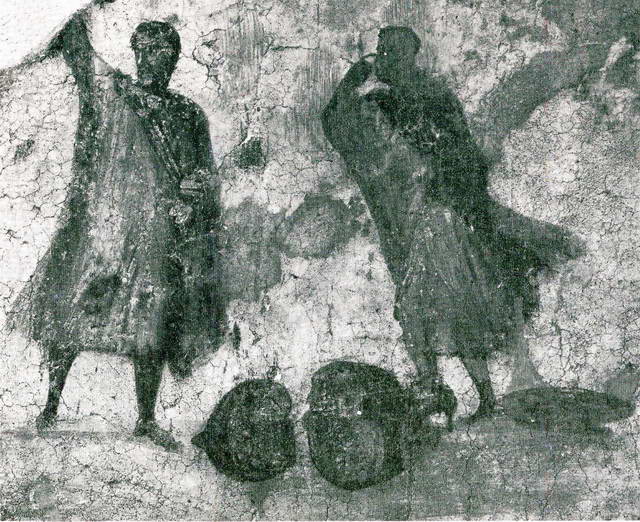
Obscurely baffling, Roman law was marked by survivals of popular and private justice. Even under the Empire it was not unusual to see justice meted out in the streets. The simplest way to force a debtor to pay up was to surprise him at home and provide him with an “escort” (convicium). The man was heaped with ridicule, and mocking songs were sung, with choruses demanding that the debt be paid. The jurists required only that the debtor not be stripped naked and that the words of the songs not be obscene. The sensibilities of the community, called to witness, had to be respected. The debtor, for his part, sought to win the public’s pity. He dressed in mourning garb and stopped cutting his hair as a sign of dereliction.
Fear of public opinion played a large role in private life, of which the public considered itself a legitimate judge. In small towns anyone who braved public opinion was hounded and mocked. He was seized, placed in a kind of hearse, and followed by a laughing and crying crowd of “mourners” before being allowed to escape. Even the dead were insulted in this way if their wills did not meet with public approval. Such greetings were also in store for stingy heirs who offended the crowd by not footing the bill for the gladiator fights expected when a notable died. In one Ligurian town the plebs halted the funeral cortege of a former officer in the town square. His family was able to take his body to the pyre only after promising to pay for a memorial spectacle.
The many, in other words, arrogated to themselves the right to judge the conduct of each individual.
Whether notable, plebian, or senator, no Roman was allowed an intimate life all his own.
Anyone could address anyone else and judge anyone else.
The least important citizen could address the “public,” which after all consisted of other citizens like himself.
UPDATE: 2007-07-10 11:30 UT: Changed image hosting facility and re-hosted image after former site reported itself as being hacked and didn’t recover after a few days.
UPDATE:
2007-10-31 17:30 UT:
Changed image hosting facility again (to Flikr this time) after next host went down and stayed down for a few days.
1 Paul Veyne, “The Roman Empire,” Chapter 1 of From Pagan Rome to Byzantium, edited by Paul Veyne, translated by Arthur Goldhammer, volume I of A History of Private Life, the Belknap Press of Harvard University Press, Cambridge, Massachusetts, 1987; pp. 165-169. Appreciation to the authors, book designers, and publishers for the image presented (p. 167). Originally published as De l’Empire romain à l’an mil, volume I of Histoire de la vie Privée, Editions du Seuil, 1985.
Labels: ancient history, ancient Rome, Roman law
Impearls: Earthdate 2005-11-05
| Jerangdu theories of male potency |
|
Glenn Reynolds the Instapundit transmits a “Message to Derbyshire,” pointing to this little piece:
JERANGDU [John Derbyshire]
A reader: “Mr. Derbyshire — One group where spouses do not share a marital bed is New Guinea's Sambia. Male potency is seen as a strange power called Jerangdu. It is kind of like the Maori's manu in that it can be transferred around. If you run out of it you die. Anyway, jerangdu is found in the semen. Women are always trying to steal the man's potency so the man must be cautious. Men sleep in the men's hut and visit the wife sparingly, less they age too quickly. It gets weirder from there…”[Derb] Thank you, Sir. Er, excuse me, guys, but don't we all sort of… believe this?
Instapundit's message shot right back at 'em? “No, we don't all believe this.”
Amusing as this is, one needn't go nearly as far away as New Guinea to find examples of that kind of ‘jerangdu’-istic thinking: indeed, peoples right here in northern California (Impearls' own home turf) subscribed to notions not dissimilar to those laid out above, which we'll report on separately (see, for instance, here, here, and here); meanwhile, as yet another stupendous example, Greco-Roman civilization was rife with the idea — yes, our classical heritage was just as into this kind of mumbo-jumbo sociosexual theorizing as any New Guinean Sambia.
Impearls' readers will recall last year's feature on
“Sex in Antiquity.”
It's worth noting that there's much more to this perplexing subject than that earlier piece could get into, so to inquire into yet another intriguing aspect of Sex in Antiquity, please scroll down, or just follow this link to
teleport
there.
UPDATE:
2009-09-06 18:00 UT:
Added links pointing to examples in A. L. Kroeber's
Labels: ancient Rome, antiquity, California Indians, New Guinea, sex
|
Sex in Antiquity II – Moral hypochondria
|
|
Resuming Impearls' look commencing last year with regard to attitudes in classical antiquity concerning
sex,
Peter Brown writing in his chapter “Late Antiquity” in A History of Private Life, Volume I, considers the ideal of deportment amongst elites versus common folk in classical Greco-Roman society.
1
What could almost be called “moral hypochondria” formed a firm barrier between the elites and their inferiors. The harmonious person, groomed by long education and shaped by the constant pressure of his peers, was thought to live at risk. He was exposed to the ever-present threat of “moral contagion” from anomalous emotions and actions, inappropriate to his own public status though acceptable in the uncultivated society of his inferiors. I use “hypochondria” advisedly, for this was the age of great doctors — most notably, the doctor Galen (a.d. 129-199) — whose works circulated widely among the wellborn.
A specific body image, formed from a conglomeration of notions inherited from the long past of Greek medicine and moral philosophy, was the physiological anchor of the moral codes of the wellborn. In this model personal health and public deportment converged with the utmost ease. In it the body is represented as a delicately maintained balance of complementary humors, whose health was upset by excessive losses of needful resources or by excessive coagulations of detrimental surpluses. The emotions that were held to disrupt or deplete the carefully balanced deportment of the well-groomed man could be traced in large part to the effects of such imbalances. The body, therefore, was regarded as the most sensitive and visible gauge of correct deportment; and the harmonious control of the body, through traditional Greek methods of exercise, diet, and bathing, was the most intimate guarantor of the maintenance of correct deportment.
The status-based, inward-looking quality of a morality rooted in an upper-class need to demonstrate social distance by means of an exceptional code of deportment is immediately apparent in the moral concerns of the Antonine age. Relations with social inferiors and sexual relations, for example, are regulated in terms of an exacting code of public deportment. To beat a slave in a fit of rage was condemned. This was not because of any very acute sense that an act of inhumanity against a fellow human being had been committed, but because the outburst represented a collapse of the harmonious image of the self of the wellborn man, and had caused him to behave in a manner as uncontrolled as a slave.
Similar concerns determined attitudes toward sexual relations. Homosexual and heterosexual love were not distinguished. What was perceived as an underlying continuity between the two was the fact of physical pleasure. Sexual pleasure as such posed no problem to the upper-class moralist. What was judged, and judged harshly, was the effect of such pleasure on the public deportment and social relations of the male. Any shame that might be attached to a homosexual relationship resided solely in the moral contagion that might cause a man of the upper class to submit himself, either physically (by adopting a passive position in lovemaking) or morally, to an inferior of either sex. The relations of men and women were subject to the same strictures. Inversions of true hierarchy through oral sexuality with a female partner were the most condemned and, not surprisingly, the most titillating, forms of collapse before the moral contagion of an inferior, the woman. Fear of effeminacy and of emotional dependence, fears based on a need to maintain a public image as an effective upper-class male, rather than any qualms about sexuality itself, determined the moral codes upon which most notables conducted their sexual life.
The fear of social subservience to an inferior was subtly buttressed by physiological anxiety. A man was a man because he moved effectively in the public world. He did this because his fetus had “cooked” more thoroughly than had a woman's in the hot womb; his body, therefore, was a reservoir of the precious “heats” on which male energy depended. Although the difference between men and women might be securely fixed, in the case of the woman by the low ceiling of her heat and the consequent frailty of her temperament, there was no such security for the active man. His heat could be lost. Excessive sexual discharge might “cool” his temperament; such a drain on his resources would be betrayed with merciless precision in a loss of momentum on the public stage. That orotund voice of the public man that Quintilian and his contemporaries so dearly loved to hear echoing through the noisy public spaces of the city was the fine fruit of a masculinity carefully preserved by “abstinence from sex.” The very real puritanism of the traditional moralities of the upper classes of the Greek and Roman worlds rested heavily on those who subscribed to them. Such puritanism did not rest on sexuality; it rested on sexuality as a possible source of moral contagion. For sexual indulgence could erode, through the effeminacy that could result from excessive sexual pleasure with partners of either sex, the unchallenged superiority of the wellborn.
Hence the unquestioning particularity of the sexual codes of the age. They did not apply to everyone. The notables might tend to subject themselves and their families to a code of dour masculine puritanism, closer to that still current in Islamic countries than to the puritanism of modern northern Europe. Yet, having drawn the carapace of deportment around themselves, they found themselves all the more free to exhibit the other side of their public selves: their popularitas. In their relations, as givers of the good things of urban life, to their inferiors, they lavished on those assumed to have cruder pleasures than themselves a succession of displays, amenities, and paintings that flatly contradicted, in their cruelty and frank obscenity, the orderly self-control these men had arrogated to themselves as the badge of their own superior status in the city. Highly cultivated aristocrats patronized the appalling bloodshed of the gladiatorial games in the Greek cities of the Antonine age. Nor did the rise of Christianity greatly change this aspect of their public life. If a modern reader remembers anything about the emperor Justinian, it is likely to be Procopius' portrait of the youthful career of his wife, Theodora: a striptease dancer in the public theater of Constantinople, geese used to peck grain from her private parts in front of an audience of thousands of citizens. What is important to bear in mind is the venomous precision of this sketch. Here was a woman of the people, to whom upper-class codes of moral restraint did not apply. Theodora is the exact inversion of the respectable upper-class wives (soberly shrouded and even secluded in Constantinople, by that time). Yet as notables, the husbands of such respectable lades had for centuries donated just such performances, to the everlasting glory of themselves and of their city.
Nor is there anything surprising in the long survival of indifference to nudity in the Roman public life.
This was not a society bound together by the implicit democracy of sexual shame.
Athletic nudity remained a mark of status for the wellborn.
The essential role of the public baths as the joining point of civic life ensured that nudity among one's peers and in front of one's inferiors was a daily experience.
The codes of deportment, as we have seen, reached down into the body itself; as a result, the clothes of the upper classes of the Antonine age, though expensive, lacked the ceremonial magnificence of later ages.
How a man carried himself, in the nude or otherwise, was the true mark of his status — a mark all the more convincing because understated.
As for women, the social shame of exposure to the wrong person, rather than the fact of exposure itself, was the principal anxiety.
Nudity before one's slaves was as morally insignificant as nudity before animals; and the physical exposure of the women of the lower classes was yet another token of their disorderly inferiority to the powerful.
1
Peter Brown, “Late Antiquity,” Chapter 2 of: From Pagan Rome to Byzantium, edited by Paul Veyne, translated by Arthur Goldhammer, volume I of:
UPDATE: 2009-09-08 17:50 UT: “Sex in Antiquity III – the Wages of Adultery” was posted on 2009-09-06. See also the earlier posted “Sex in Antiquity I.”
Labels: ancient Rome, antiquity, Peter Brown, sex
Impearls: Earthdate 2004-07-30
| Sex in Antiquity |
People nowadays have a conception of the pre-Christian era as free from the hangups about sensuality and especially sexuality that we're familiar with today, that we think began as a result of the advent of Christianity and the sexual strictures that it brought. Little could be farther from the truth in terms of attitudes during Classical Greek and Roman times towards these subjects.
We return again to that fascinating multi-volume historical series A History of Private Life, which we have had occasion to refer to here at Impearls in the past. From the title one might be inclined to think that the series is just a light-hearted, ribald catalog of sexual escapades from the past. The series scope extends across much more than that, however. Volume I, for example, titled From Pagan Rome to Byzantium, edited by Paul Veyne, includes a terrific chapter, almost 100 pages in length, delving into manifold aspects of the Roman home or domus, including detailed analysis of the architecture of various Roman homes, how the domus functioned as house and economic unit, and the manner in which “private” and “public” spaces were laid out both within it and the Roman city as a whole.
The book also considers deeply how and why the concept of the “private life” of individuals came to be distinguished from their “public life” and the consequences of that fateful division; and later on, how the barbarian invasions of the West scrambled these hard-won distinctions, turning the entire state — a res publica or “public thing,” an incomprehensible concept to the barbarians — in effect into a private estate to be exploited mercilessly by the invaders. Despite their significance and interest, we will not consider these important matters at this point; see the volumes of the series for much more on the distinguishing of “private” versus “public” in history.
In this series we will delve into that other vital aspect of “private life,” sex and, later on, its institutionalized companions, marriage and “the couple,” in classical antiquity. As Paul Veyne writes in his chapter “The Roman Empire” in Volume I: 1
[I]ncoherences and baffling limitations are found in every century. In Greco-Roman culture we find them associated with another pleasure: love. If any aspect of ancient life has been distorted by legend, this is it. It is widely but mistakenly believed that antiquity was a Garden of Eden from which repression was banished, Christianity having yet to insinuate the worm of sin into the forbidden fruit. Actually, the pagans were paralyzed by prohibitions. The legend of pagan sensuality stems from a number of traditional misinterpretations. The famous tale of the debauches of Emperor Heliogabalus is nothing but a hoax perpetrated by the literati who authored that late forgery, the Historia Augusta. The legend also stems from the crudeness of the interdictions: “Latin words are an affront to decency,” people used to say. For such naive souls, merely uttering a “bad word” provoked a shiver of perverse imagination or a gale of embarrassed laughter. Schoolboy daring.
What were the marks of the true libertine? A libertine was a man who violated three taboos: he made love before nightfall (daytime lovemaking was a privilege accorded to newlyweds on the day after the wedding); he made love without first darkening the room (the erotic poets called to witness the lamp that had shone on their pleasures); and he made love to a woman from whom he had removed every stitch of clothing (only fallen women made love without their brassieres, and paintings in Pompeii's bordellos showed even prostitutes wearing this ultimate veil). Libertines permitted themselves to touch rather than caress, though with the left hand only. The one chance a decent man had of seeing a little of his beloved's naked skin was if the moon happened to fall upon the open window at just the right moment. About libertine tyrants such as Heliogabalus, Nero, Caligula, and Domitian it was whispered that they had violated other taboos and made love with married women, well-bred maidens, freeborn adolescents, vestal virgins, or even their own sisters.
This puritanism went hand in hand with an attitude of superiority toward the love object, who was often treated like a slave. The attitude emblematic of the Roman lover was not holding his beloved by the hand or around the waist or, as in the Middle Ages, putting his arm around her neck; the woman was a servant, and the lover sprawled on top of her as though she were a sofa. The Roman way was the way of the seraglio. A small amount of sadism was permissible: a slave, for example, could be beaten in her bed, on the pretext of making her obey. The woman served her lord's pleasure and, if necessary, did all the work herself. If she straddled her passive lover, it was to serve him.
Machismo was a factor. Young men challenged one another in a macho fashion. To be active was to be a male, regardless of the sex of the passive partner. Hence there were two supreme forms of infamy: to use one's mouth to give a woman pleasure was considered servile and weak, and to allow oneself to be buggered was, for a free man, the height of passivity (impudicitia) and lack of self-respect. Pederasty was a minor sin so long as it involved relations between a free man and a slave or person of no account. Jokes about it were common among the people and in the theater, and people boasted of it in good society. Nearly anyone can enjoy sensual pleasure with a member of the same sex, and pederasty was not at all uncommon in tolerant antiquity. Many men of basically heterosexual bent used boys for sexual purposes. It was proverbially held that sex with boys procures a tranquil pleasure unruffling to the soul, whereas passion for a woman plunges a free man into unendurable slavery.
Thus, Roman love was defined by macho domination and refusal to become a slave of passion. The amorous excesses attributed to various tyrants were excesses of domination, described with misleading Sadian boldness. Nero, a tyrant who was weak more than cruel, kept a harem to serve his passive needs. Tiberius arranged for young slave boys to indulge his whims, and Messalina staged a pantomime of her own servility, usurping the male privilege of equating strength with frequency of intercourse. These acts were not so much violations as distortions of the taboos. They reflect a dreadful weakness, a need for planned pleasure. Like alcohol, lust is dangerous to virility and must not be abused. But gastronomy scarcely encourages moderation at table.
Amorous passion, the Romans believed, was particularly to be feared because it could make a free man the slave of a woman. He will call her “mistress” and, like a servant, hold her mirror or her parasol. Love was not the playground of individualists, the would-be refuge from society that it is today. Rome rejected the Greek tradition of “courtly love” of ephebes, which Romans saw as an exaltation of pure passion (in both senses of “pure,” for the Greeks pretended to believe that a man's love for a freeborn ephebe was Platonic). When a Roman fell madly in love, his friends and he himself believed either that he had lost his head from overindulgence in sensuality or that he had fallen into a state of moral slavery. The lover, like a good slave, docilely offered to die if his mistress wished it. Such excesses bore the dark magnificence of shame, and even erotic poets did not dare to glorify them openly. They chose the roundabout means of describing such behavior as an amusing reversal of the normal state of affairs, a humorous paradox.
Petrarch's praise of passion would have scandalized the ancients or made them smile. The Romans were strangers to the medieval exaltation of the beloved, an object so sublime that it remained inaccessible. They were strangers, too, to modern subjectivism, to our thirst for experience. Standing apart from the world, we choose to experience something in order to see what effect it has, not because it is intrinsically valuable or required by duty. Finally, the Romans were strangers to the real paganism, the at times graceful and beautiful paganism of the Renaissance. Tender indulgence in pleasures of the senses that became, also, delights of the soul was not the way of the ancients. The most Bacchic scenes of the Romans have nothing of the audacity of some modern writers. The Romans knew but one variety of individualism, which confirmed the rule by seeming to contradict it: energetic indolence. With secret delight they discussed senators such as Scipio, Sulla, Caesar, Petronius, and even Catiline, men scandalously indolent in private yet extraordinarily energetic in public. It was an open secret among insiders that these men were privately lazy, and such knowledge gave the senatorial elite an air of royalty and of being above the common law while confirming its authentic spirit. Although the charge of energetic indolence was a reproach, it was also somehow a compliment. Romans found this compliment reassuring. Their brand of individualism sought not real experience, self-indulgence, or private devotion, but tranquilization.
1
Paul Veyne, Chapter 1: “The Roman Empire,” Volume I: From Pagan Rome to Byzantium, edited by Paul Veyne, translated by Arthur Goldhammer, A History of Private Life, the Belknap Press of Harvard University Press, Cambridge, Massachusetts, 1987;
UPDATE: 2009-09-08 17:50 UT: “Sex in Antiquity II – Moral hypochondria” and a preliminary piece “Jerangdu theories of male potency” were posted on 2005-11-05.
UPDATE: 2009-09-08 17:50 UT: “Sex in Antiquity III – the Wages of Adultery” was posted on 2009-09-06.
Labels: ancient Rome, antiquity, Paul Veyne, sex
Impearls: Earthdate 2004-06-26
| Greater Armenia |
Joel in his intriguing Far Outliers blog, which we've had occasion to mention before here at Impearls, has been quoting from Robert D. Kaplan's year 2000 book Eastward to Tartary: Travels in the Balkans, the Middle East, and the Caucasus, providing fascinating glimpses of Armenia, Trabzon (the medieval Byzantine city of Trebizond) and other formerly Armenian-populated portions of present day Turkey, as well as of Azerbaijan.
Our only disappointment is that Kaplan provides too scanty a view of Armenian history, most particularly the medieval period when Greater Armenia, including far more than the present Armenian Republic, was in its heyday. To remedy this drawback Impearls proceeds to reveal its own look at medieval Armenian history, drawing from a now public-domain chapter in the first edition of the renowned Cambridge Medieval History, by early twentieth century French scholar of Armenia Frédéric Macler (1869-1938), Professor of Armenian for many years at the École nationale des Langues orientales vivantes, Paris. 1
We will also make frequent reference to the splendid pictorial “VirtualAni” site, which folks definitely ought not miss.
Following is an index of the parts into which Frédéric Macler's chapter “Armenia” has been divided:
Greater Armenia→ Introduction
→ The Arab Conquest
→ Recovery and Independence
→ The Arabs return, but are driven out
→ (Mostly) Peace and prosperity
→ Greeks and Turks
→ Little Armenia and Aftermath
→ Acknowledgments and References
→ (End)
UPDATE: 2004-07-03 17:50 UT: Corrected a few typos; modified photograph usage at the request of VirtualAni.
UPDATE: 2004-07-13 14:00 UT: Joel at Far Outliers, whose posting inspired this whole thing, has linked back to this article (under the title “Greater Armenia Impearled”) with lengthy quotations and the comment, “To add depth to the brief mentions of Armenia on this blog and elsewhere, the wonderfully informative Impearls ‘proceeds to reveal its own look at medieval Armenian history […].’ I'll post just a few paragraphs from each part. Visit Impearls for the rest, plus illustrations, maps, notes, and acknowledgments.”
Jakub at a site called Social Bookmarks has linked to this piece, under the title “Medieval Armenia.”
Nathan at an interesting blog I hadn't previously been aware of called The Argus, devoted as it says to “watching Central Asia and the Caucasus,” linked to this article, commenting “The extent of my what I can say I definitely know about Armenia is its location and that it has a long and fascinating history. Joel points to a series of posts from Impearls on Medieval Armenia. Don't miss it!”
Matt at another blog new to me called Blogrel (which I'd thought was a cute bloggish pun on “doggerel,” but is actually a union of “blog” plus the word grel meaning “to write” in Armenian) then linked to the piece, adding: “Impearls has a detailed post about Greater Armenia (Via The Argus). It's an ‘all you ever wanted to know about historical Armenia but were afraid to ask.’ […] This is a novel use of a blog. A blog about history. One thing is I don't see any way to make comments, but maybe that's a good idea. Make sure you have a good cup of haykakan surtch and read the full post.”
Last but not least, Geitner Simmons at his wide-ranging Regions of Mind blog, has linked to the Armenia piece (along with our Northwestern California article) with the comment: “Michael McNeil continues to demonstrate creativity at his blog Impearls. Michael has put together a spectacular package about early Armenian history. In another post, he examines some aspects of natural history in California's Klamath Mountains. The graphics are first-rate — a wide range of architectural and cultural images involving Armenia, plus a terrific satellite photo and mountain images in regard to northwestern California. Michael's look at Armenia underscores the devastation and brutality involved as warring empires and kingdoms struggled for control.” Geitner illustrates with his own striking photo of a structure dating from early medieval Armenia.
UPDATE: 2009-11-09 13:10 UT: Updated to fix broken picture links, and a couple of lingering typos.
Labels: ancient Rome, antiquity, Arab civilization, Armenia, Byzantium, medieval
| (Blank last screen) |
|

![[Powered by Blogger]](http://buttons.blogger.com/bloggerbutton1.gif)
2002-11-03 2002-11-10 2002-11-17 2002-11-24 2002-12-01 2002-12-08 2002-12-15 2002-12-22 2002-12-29 2003-01-05 2003-01-12 2003-01-19 2003-01-26 2003-02-02 2003-02-16 2003-04-20 2003-04-27 2003-05-04 2003-05-11 2003-06-01 2003-06-15 2003-06-22 2003-06-29 2003-07-13 2003-07-20 2003-08-03 2003-08-10 2003-08-24 2003-08-31 2003-09-07 2003-09-28 2003-10-05 2003-10-26 2003-11-02 2003-11-16 2003-11-23 2003-11-30 2003-12-07 2003-12-14 2003-12-21 2003-12-28 2004-01-04 2004-01-11 2004-01-25 2004-02-01 2004-02-08 2004-02-29 2004-03-07 2004-03-14 2004-03-21 2004-03-28 2004-04-04 2004-04-11 2004-04-18 2004-04-25 2004-05-02 2004-05-16 2004-05-23 2004-05-30 2004-06-06 2004-06-13 2004-06-20 2004-07-11 2004-07-18 2004-07-25 2004-08-22 2004-09-05 2004-10-10 2005-06-12 2005-06-19 2005-06-26 2005-07-03 2005-07-10 2005-07-24 2005-08-07 2005-08-21 2005-08-28 2005-09-04 2005-09-11 2005-09-18 2005-10-02 2005-10-09 2005-10-16 2005-10-30 2005-11-06 2005-11-27 2006-04-02 2006-04-09 2006-07-02 2006-07-23 2006-07-30 2007-01-21 2007-02-04 2007-04-22 2007-05-13 2007-06-17 2007-09-09 2007-09-16 2007-09-23 2007-10-07 2007-10-21 2007-11-04 2009-06-28 2009-07-19 2009-08-23 2009-09-06 2009-09-20 2009-12-13 2011-03-27 2012-01-01 2012-02-05 2012-02-12