|
|
Blogroll
|
|
Most recent articles |
|
Highlights |
|
States and Economies |
|
World economies: 15 of 50 largest economies are U.S. States: |
|
World States – Table 1 |
|
History and Society |
|
Fourth of July aboard the W.W. II aircraft carrier the U.S.S. Hornet |
|
A. L. Kroeber's The Civilization of California's Far Northwest |
|
The Arab Admiralty – and an Arab naval view of the Crusades |
|
Excerpt from “The Wife of Bath's Prologue” by Geoffrey Chaucer |
|
“Horsey” Vikings: exploring origin of the “Rohirrim” in The Lord of the Rings
|
|
The Battle of Crécy by Winston S. Churchill |
|
Monotheistic Paganism, or just what was it Christianity fought and faced? |
|
Medieval constipation advice for travelers: “A ripe turd is an unbearable burden” |
|
Alexis de Tocqueville's bicentennial: Anticipatory censorship in colonial America |
|
Antiquity vs. Modernity: Alexis de Tocqueville on the mind of the slaveholder vs. soul of America |
|
Federalism, and Alexis de Tocqueville on the origins of American democracy |
|
Science, Technology, Space |
|
Looking in the right direction – towards the future – with regard to global warming |
|
Know Your Neighborhood: from Andromeda to Fermions and Bosons |
|
Magnetars and Pulsars: Science's special section on pulsars |
|
The Geneva-Copenhagen Survey of Sun-like Stars in the Milky Way |
|
Galactic Central: the Black Hole at the Center of the Galaxy |
|
Politics and War |
|
America’s strong arm, wielding the Sword of Iraq, slays the multi-headed Hydra of Al Qaeda |
|
Regional and Personal |
|
Tamara Lynn Scott |
What wailing wight
Calls the watchman of the night?
William Blake
Whirl is king
Aristophanes
“Jumping into hyperspace ain't like dustin' crops, boy.”
Han Solo, another galaxy
|
Blogroll |
|
Grand Central Station |
|
Legal and Economic |
|
History and Society |
|
Science, Technology, Space |
|
Politics and War |
|
Eclectic |
|
Regional |
|
Reciprocal |
© Copyright 2002 – 2009
Michael Edward McNeil
Impearls: Earthdate 2009-09-06
| Sex in Antiquity III – the Wages of Adultery |
|
I've been watching the first couple seasons of the BBC series Rome, checked out from the library. Covering the period of Caesar and Octavian, it's pretty entertaining, especially considering the various antics and tribulations that Vorenus and Pullo, two non-historical characters whose supposed lives we follow through the history, get into (I won't spoil it for folks by detailing them).
Rome as a production does appear to go to some effort trying to get its portrait of classical history and civilization basically correct, but can be seen to fail on occasion. I was amused by a scene in season two where a high-status woman who is having an affair with a man is quite offended when he attempts to offer her money, rejecting it as portraying her as a prostitute — which it turns out is quite ahistoric, merely projecting modern attitudes onto a very different antique society.
As Paul Veyne writes in his chapter “The Roman Empire” in Volume I of A History of Private Life: 1
The social and institutional character of the Roman economy was so different from that of our own that it is tempting to call it archaic. It sustained, nevertheless, a high level of production and was as dynamic and ruthless as capitalism. For, if Roman aristocrats distinguished themselves by their culture and their interest in philosophy, they were still avid for profit.
The greatest nobles talked business. Pliny, a senator, in letters intended to be specimens of the finest in the genre, held up his behavior as a wealthy landlord as an example for others to follow. When a noble wished to get rid of old furniture or building materials, he held a public auction. (Auctions were the normal way for private individuals to sell their used belongings; the emperors themselves auctioned off unwanted palace furniture.)
Money was not supposed to lie idle. Even loans to friends and relatives earned interest (not charging interest on such loans was considered a mark of special virtue). A woman's father had to pay interest to her husband if transfer of her dowry was delayed.
Usury was a part of daily life; modern anti-Semites might have made ancient Rome the object of their obsession instead of the Jews. In Rome commerce and money-lending were not left exclusively to professionals or to any one class of society. Any toil, no matter how pleasurable, merited payment.
One picturesque aspect of amorous customs among the Romans was that the female partner in a high-society affair was paid for her trouble. A matron who deceived her husband received a large sum or, in some cases, an annual income from her lover. Some cads reclaimed these gifts when affairs were broken off, and on occasion the courts became involved.
The practice of accepting gifts from lovers was considered not prostitution but work for hire. The woman did not give herself because she was paid, the jurists held; she was rewarded for giving herself of her own free will. She who loved best was most handsomely paid. Women sought the wages of adultery as eagerly as men sought dowries.
1
Paul Veyne, Chapter 1: “The Roman Empire,” Volume I: From Pagan Rome to Byzantium, edited by Paul Veyne, translated by Arthur Goldhammer, A History of Private Life, the Belknap Press of Harvard University Press, Cambridge, Massachusetts, 1987;
UPDATE: 2009-09-08 17:40 UT: See also the earlier posted “Sex in Antiquity I” and “Sex in Antiquity II – Moral hypochondria.”
UPDATE: 2009-09-06 16:00 UT: University of Wisconsin law professor Ann Althouse had a posting this last week “From an expert on ‘the etiquette of open marriages’,” quoting that “expert” as saying, “I'm a class act in infidelity.” Note that I have no reason to think that Althouse (who was only just married herself a few weeks back) supports this “class act's” position in this regard (quite the contrary, I think), but a poster on that Althouse thread made a comment which enhances my point above concerning the profound differences between cultures, ancient and modern, in this connection.
As “cubanbob” put it in that thread (emphasis added):
Years ago when I traveled to Taiwan extensively on business it was expected that a successful man have a mistress. Indeed if he did not have one it would almost [be] a loss of face. However the rules were very clear:
1 — never be seen in public with the mistress, especially with by people who know the wife. Under no circumstances can the wife be subject to embarrassment.
2 — no outside children or STD's.
3 — home every day at a reasonable hour and on weekends [to] spend time with the kids. The wife must be able to maintain the fiction that there is no affair indeed it is the desired goal that [she] should not even be aware there is a mistress. Only the close circle of the boys at the club can know.
4 — money is always left on the night stand by the bed after sex with the mistress. If she refuses to take the money the affair is to be ended immediately. Even if she loves him, she must take the money otherwise he must end it. As long as she takes the money she has no claim on him.
5 — If the wife is publicly humiliated by the husband due to his having an affair, the punishment for the husband is to be left essentially penniless as she can never remarry (or at least in socially acceptable circles) and the money is her compensation.
It's been a while since I [have] last been there, I wonder if those unwritten rules are still in effect. As for the woman in the article, she should know that discretion is the only way something like that can be made to work. So why openly comment on your marriage and embarrass your husband? She will find her herself divorced soon enough.
Labels: adultery, ancient Rome, Ann Althouse, antiquity, BBC Rome series, open marriage, Paul Veyne, Roman law, sex, Taiwan, usury
Impearls: Earthdate 2007-11-10
| Apotheosis in the American duumvirate |
|
In Impearls' earlier piece on the “Constitution of the Roman city-state,” notice was paid to the fact that the principal officers of the Roman civitas (city-state or county) were a duo who were typically termed duumvirs and the system was thereby a duumvirate (literally “two-man-office”); to the tail end of which I thereby tacked on a postscript, to wit:
I'm no fan of American paleoconservative Patrick Buchanan, but I almost fell out of my chair a while back when I heard him (on PBS's McLaughlin Group) refer to Bush/Cheney as “duumvirs.” Somehow it had hitherto escaped my notice, but “duumvir” and “duumvirate” are actually English words (as well as Latin), and — along with triumvirate, etc. — are present in English dictionaries.
In the American Presidential system, the U.S. President/Vice-President clearly more closely resemble the Roman Emperor/Vice-Emperor (known titularly as the Augustus/Cæsar), wherein one member of the official dyad is institutionally superior to the other (though the U.S. President can't fire the Vice President) — as opposed to the Roman municipal (along with Roman Republican) system detailed heretofore, in which the duumvir (consul) magistrate pairs are institutionally equal in status and powers, each magistrate also possessing the power of vetoing his colleague's actions and decisions. Either approach can presumably be properly termed a kind of duumvirate and its official magistrates duumvirs.
That then drew this reply from Impearls reader Circe:
Well, I wouldn't hold your breath for any posthumous deification of Bush. Though if I see any depictions of Bush apotheosis, I'll let ya know.
(Laughing.) That's pretty funny! Taking the point semi-seriously though, I suspect — the malady known as “Bush Derangement Syndrome” being as prevalent as it is at present — quite a number of BDS-affected souls would like or at least fantasize treating the President of the United States as Nero was. Bush, however, is fairly young and will in bit over a year (unlike Nero) voluntarily leave office; thereafter (barring untoward events) he's likely to live for a number of decades yet. Given that, who knows how public opinion will shift by the time the matter truly is “postumous”? Recall that Truman ended his term in office highly unpopular (locked in a stalemated war that cost nearly as many American lives as the Vietnam War did to boot), and yet look how he's regarded now.
The essential point, of course, is that the United States (in its executive branch) is a constitutional duumvirate — a feature in my view probably copied by the American founding fathers (I suspect principally James Madison) directly from the Roman model. Certainly there's nothing among America's British and Continental political forebears (other than the Roman) similar to the U.S. President and Vice President. (That and other resemblances between the Roman and American constitutional systems probably deserve a further posting one of these days to properly consider the matter.)
Beyond that, folks who disbelieve that America (as well as Rome) has “apotheosized” (honorarily deified) at least some past Presidents (as Rome did some of its Emperors) need look no further than the overlooming fresco encompassing the dome of nothing less than the Capitol of the United States (Congress's designated assembly hall, as the Roman Capitol was for the Senate in Rome), revealing emigre Italian artist
Constantino Brumidi's
stunning masterpiece “The Apotheosis of Washington”….
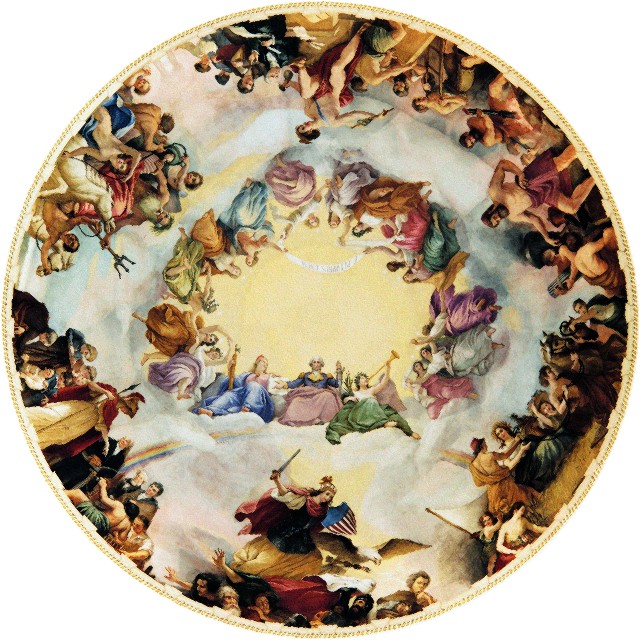

George Washington — General principally responsible for his country's independence, chairman of its constitutional convention, and first President of the United States — sits enthroned over a rainbow.
With a gesture at the Constitution/Law, flanked by the goddesses of Liberty (holding the traditional Roman fasces of authority) and Victory/Fame (cradling the palm of victory whilst flourishing the clarion of fame) — haloed round by a constellation of thirteen Starry maidens hoisting a banner proclaiming E Pluribus Unum — the apotheosized Washington regards us from on high as the Lord of Hosts.

f1 Constantino Brumidi, “The Apotheosis of Washington,” 1865, Capitol of the United States.
f2 Constantino Brumidi, Detail: George Washington as Lord of Hosts, from “The Apotheosis of Washington,” 1865, Capitol of the United States.
f3 Constantino Brumidi, Detail: E Pluribus Unum, from “The Apotheosis of Washington,” 1865, Capitol of the United States.
1
Dan Brown,
The Lost Symbol
(novel).
UPDATE: 2009-09-22 17:50 UT: This piece was published nearly two years ago, but about a week back a mass of Google image searches pointing at Brumidi's “Apotheosis of Washington” fresco pictured in this article began bringing in a flood of thousands of visitors — on a daily basis almost an order of magnitude greater than Impearls' usual traffic — which is still ongoing. Would one of these visitors please e-mail me or add a comment to the effect of what the source of their sudden inspiration for doing that search was?
One might also note that December 14 of this year 2009 local time (Earthdate 2009-12-15 03:00 UT) will be the 210th anniversary of George Washington's death (apotheosis) in 1799. Impearls plans another article on Washington for that occasion.
UPDATE: 2009-09-28 02:00 UT: Reader Kaitie Marie responded to my appeal for information concerning how the recent flood of visitors to Impearls as a result of web searches for the Apotheosis of Washington got their inspiration to do so, posting a recent comment:
Thanks, Kaitie! No doubt you're right that that's the explanation, and thanks too for your kind words about Impearls. One might note that the rate of visitors has continued to rocket up over the last few days, reaching a new (at least recent) record of 820 visitors just during the last day. Welcome, everybody, and I hope that many of you, like Kaitie, will continue to stop by.The Apotheosis of Washington is mentioned in Dan Brown's new book, The Lost Symbol. 1 The book describes what the frescoe looks like and mentions some of its symbolism. When you google search for the piece under images, this website is in the first two or three results and this is probably the reason that you've been seeing such an influx of new visitors. That said, I'm glad that I came across this blog and look forward to reading your other posts. The diversity of subject matter and obvious research that you've put into your posts is impressive.
As mentioned in the earlier update above, in December of this year (2009) Impearls will publish a more in depth memoriam concerning the character of George Washington for the 210th anniversary of his death (or “apotheosis”), for which numerous additional images of paintings and sculpture by Brumidi and others are planned revealing the depth of the acclaim that Washington has earned in the minds of the American people. In the meantime, folks might like to check out this fascinating book about the artist Constantino Brumidi including many more images of paintings by him which appear in the U.S. Capitol and elsewhere, available on-line at the U.S. Government Printing Office.
UPDATE: 2009-10-08 19:50 UT: A site named Mahalo: Human-Powered Search, in a posting titled “Apotheosis Of Washington,” has linked to this article. Also, the blizzard of visitors searching for the images in this posting, referred to in earlier updates above, reached a peak on Earthdate 2009-09-28 with 971 visitors arriving that day.
Labels: American history, apotheosis, constitution, George Washington, Roman law
Impearls: Earthdate 2007-10-13
| Constitution of the Roman city-state |
|
![Fig. 1. Map of Roman Silchester (Calleva Atrebatum) [click on image for larger image] (Courtesy: Director, Reading Museum) (Sheppard Frere, Oxford University)](http://farm3.static.flickr.com/2190/1622762059_80609a97d4_o.jpg "Fig. 1. Map of Roman Silchester (Calleva Atrebatum) [click on image for larger image] (Courtesy: Director, Reading Museum) (Sheppard Frere, Oxford University)")
Impearls’ earlier piece on the autonomy of cities and provincial peoples in the Roman Empire deserves a more thoroughgoing follow-up, in my view. To answer the implicit question posed in that preceding piece — namely, how did those cities do it? — we’ll spend the remainder of this essay (organized as usual in such cases in Impearls, as an associated set of postings occupying a single archive page) considering the matter.
Turning once again to historian G. H. (George Hope) Stevenson’s (Fellow and Praelector in Ancient History, University College, Oxford) oddly fascinating work Roman Provincial Administration (1939, which we’ve referred to before) for pertinent details, we draw from (the entirety — at least for now excepting most footnotes — of) Prof. Stevenson’s final Chapter VI: “The [Roman] Municipal System in the Provinces,” to explain how all those splendid, autonomous cities spangling the diverse extent of the vast empire, organized their own affairs to accomplish the job of self-government. 1
To accompany the chapter from Stevenson’s book, a Foreword to the beginning as well as an Afterword providing ex post facto observations have been attached, bracketing Stevenson’s essay. In a subsequent posting to follow on later we’ll also try to add further illuminating comparisons that can be undertaken with regard to these Roman provincial self-governing states.
Now, forthwith the hypertext Contents to G. H. Stevenson’s “The Roman municipal system in the provinces” (including fore and after commentary).
- Foreword by Michael McNeil
- The situation in the provinces
- Types of provincial city
- Constitution of the Civitas
- Municipal revenues and expenditure
- Interference of the central government
- Verdict
- Afterword by Michael McNeil
- References
- End
Labels: ancient history, ancient Rome, constitution, Roman law
Impearls: Earthdate 2007-04-28
| Roman Law foibles in antiquity by Paul Veyne |
|
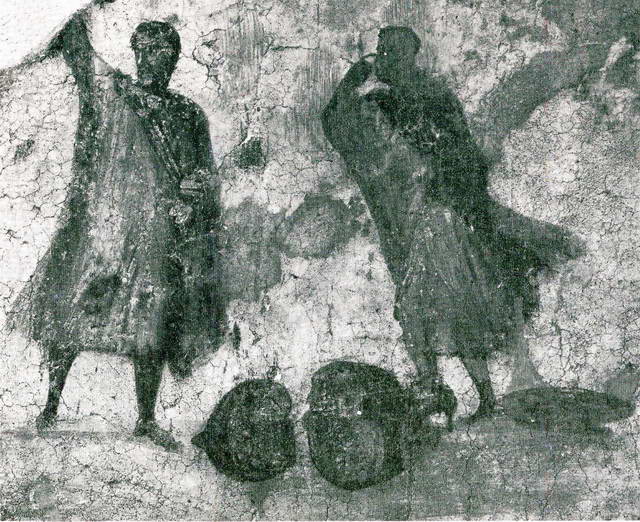
For its insights into antique society, we return to an old favorite read — Paul Veyne’s A History of Private Life: from Pagan Rome to Byzantium — on a topic different from
“Sex
in
Antiquity”
this time.
On this occasion, we’ll consider some peculiarities of Roman law and convention in antiquity, compared with what seems natural to us today.
1
(Then, too, one may also view
Winston Churchill’s
comments with regard to Roman vs. Common Law in the modern age.)
In normal times civil law accurately reflected Roman mores. Law and morality were linked by an umbilical cord that was never really cut. Although technically complex, Roman civil law was more verbal than conceptual, and scarcely deductive. It afforded professional students plenty of opportunity to demonstrate their virtuosity. Did it enable ordinary people to obtain justice, however? Did it enforce respect for the rules when people violated them and oppressed their neighbors? In a society as unequal and inegalitarian as the Roman, it is obvious that formal rights, however clear, had no reality, and that a weak man had little to gain by going to court against powerful enemies. But even when the law was not simply violated, did it provide means of enforcing people’s rights? One example will suffice, I think, to show that the public authorities did not so much supplant private vendettas as organize them.
Suppose I lend money to someone who decides not to pay me back. Or, better still, suppose that all I own in the world is a small farm, to which I am attached because my ancestors lived there and the country is pleasant. A powerful neighbor covets my property. Leading an army of slaves, he invades my land, kills those of my slaves who try to defend me, beats me with clubs, drives me from my land, and seizes my farm. What can I do? A modern citizen might say, go to court (litis denuntiatio) to obtain justice and persuade the authorities to restore my property (manu militari). And this was indeed what would have happened toward the end of antiquity, when provincial governors finally succeeded in imposing their idea of public coercion. But in Italy in the first two centuries a.d. events would have taken a different turn.
For one thing, the aggression against me by my powerful neighbor would have been considered a strictly civil offense; it would not have been covered by a penal code. It would have been up to me, as plaintiff, to see to it that the defendant appeared in court. In other words, I would have had to snatch the defendant from the midst of his private army, arrest him, and hold him in chains in my private prison until the day of judgment. Had this been beyond my power, the case could never have been heard (litis contestatio). But suppose that I did manage to bring the defendant into court and, thanks to the intervention of a powerful man who had taken me on as client, succeeded in obtaining justice, meaning that the court declared the law to be on my side. It then would have been up to me to enforce that judgment, if I could. Was I obligated to recapture my ancestral farm by myself? No. By an inexplicable twist in the law, a judge could not sentence a defendant simply to restore what he had taken. Leaving my farm to its fate, the judge would authorize me to seize my adversary’s chattels real and personal and sell them at auction, keeping a sum equal to the value placed on my farm by the court (aestimatio) and returning the surplus to my enemy.
Who would have considered recourse to a system of justice so little interested in punishing social transgressions? Most likely two types of people. When powerful, stubborn men quarreled over a piece of land, both parties wished to be judged to have the better case by the many Romans who followed trials in the courts because they found chicanery or legal eloquence to their taste. Such men would have settled their dispute in the courts, as they might have settled it at other times in history in a duel before witnesses. Or a creditor might bring suit against a debtor in default, who was scarcely in a position to put up a fight. The creditor would already have seized the debtor, who might at first have attempted to hide. Ulpian tells of one debtor who stayed away from the public market in order to avoid running into his creditor. When he saw him, he quickly hid behind the columns of the courtyard or one of the many kiosks in the marketplace. Recourse to the law was therefore just one of the many possible moves in the social game, and some people begged that it never be used against them Juris consultis abesto, “No lawyers in this business!”
Apart from its strategic uses, the law formed part of the substance of the old Roman culture. To have recourse to law, to make learned use of the ins and outs of civil law, was sophisticated behavior. Consider the following example. In theory, no Roman woman could take a case to court without a male representative (although this rule of law was honored mainly in the breach). A non-Roman inhabitant of the Empire, a Greek or Egyptian woman, say, had even less right to take her case to court. Yet the papyri tell us that many such women went to court anyway. What was the rule? We are obliged to admit that there was none. And we discover, too, that many Roman women chose male representatives even though it was not strictly necessary. Although there was no rule, there were elegant, or perhaps pedantic, ways of going about things.
Obscurely baffling, Roman law was marked by survivals of popular and private justice. Even under the Empire it was not unusual to see justice meted out in the streets. The simplest way to force a debtor to pay up was to surprise him at home and provide him with an “escort” (convicium). The man was heaped with ridicule, and mocking songs were sung, with choruses demanding that the debt be paid. The jurists required only that the debtor not be stripped naked and that the words of the songs not be obscene. The sensibilities of the community, called to witness, had to be respected. The debtor, for his part, sought to win the public’s pity. He dressed in mourning garb and stopped cutting his hair as a sign of dereliction.
Fear of public opinion played a large role in private life, of which the public considered itself a legitimate judge. In small towns anyone who braved public opinion was hounded and mocked. He was seized, placed in a kind of hearse, and followed by a laughing and crying crowd of “mourners” before being allowed to escape. Even the dead were insulted in this way if their wills did not meet with public approval. Such greetings were also in store for stingy heirs who offended the crowd by not footing the bill for the gladiator fights expected when a notable died. In one Ligurian town the plebs halted the funeral cortege of a former officer in the town square. His family was able to take his body to the pyre only after promising to pay for a memorial spectacle.
The many, in other words, arrogated to themselves the right to judge the conduct of each individual.
Whether notable, plebian, or senator, no Roman was allowed an intimate life all his own.
Anyone could address anyone else and judge anyone else.
The least important citizen could address the “public,” which after all consisted of other citizens like himself.
UPDATE: 2007-07-10 11:30 UT: Changed image hosting facility and re-hosted image after former site reported itself as being hacked and didn’t recover after a few days.
UPDATE:
2007-10-31 17:30 UT:
Changed image hosting facility again (to Flikr this time) after next host went down and stayed down for a few days.
1 Paul Veyne, “The Roman Empire,” Chapter 1 of From Pagan Rome to Byzantium, edited by Paul Veyne, translated by Arthur Goldhammer, volume I of A History of Private Life, the Belknap Press of Harvard University Press, Cambridge, Massachusetts, 1987; pp. 165-169. Appreciation to the authors, book designers, and publishers for the image presented (p. 167). Originally published as De l’Empire romain à l’an mil, volume I of Histoire de la vie Privée, Editions du Seuil, 1985.
Labels: ancient history, ancient Rome, Roman law
| (Blank last screen) |
|

![[Powered by Blogger]](http://buttons.blogger.com/bloggerbutton1.gif)
2002-11-03 2002-11-10 2002-11-17 2002-11-24 2002-12-01 2002-12-08 2002-12-15 2002-12-22 2002-12-29 2003-01-05 2003-01-12 2003-01-19 2003-01-26 2003-02-02 2003-02-16 2003-04-20 2003-04-27 2003-05-04 2003-05-11 2003-06-01 2003-06-15 2003-06-22 2003-06-29 2003-07-13 2003-07-20 2003-08-03 2003-08-10 2003-08-24 2003-08-31 2003-09-07 2003-09-28 2003-10-05 2003-10-26 2003-11-02 2003-11-16 2003-11-23 2003-11-30 2003-12-07 2003-12-14 2003-12-21 2003-12-28 2004-01-04 2004-01-11 2004-01-25 2004-02-01 2004-02-08 2004-02-29 2004-03-07 2004-03-14 2004-03-21 2004-03-28 2004-04-04 2004-04-11 2004-04-18 2004-04-25 2004-05-02 2004-05-16 2004-05-23 2004-05-30 2004-06-06 2004-06-13 2004-06-20 2004-07-11 2004-07-18 2004-07-25 2004-08-22 2004-09-05 2004-10-10 2005-06-12 2005-06-19 2005-06-26 2005-07-03 2005-07-10 2005-07-24 2005-08-07 2005-08-21 2005-08-28 2005-09-04 2005-09-11 2005-09-18 2005-10-02 2005-10-09 2005-10-16 2005-10-30 2005-11-06 2005-11-27 2006-04-02 2006-04-09 2006-07-02 2006-07-23 2006-07-30 2007-01-21 2007-02-04 2007-04-22 2007-05-13 2007-06-17 2007-09-09 2007-09-16 2007-09-23 2007-10-07 2007-10-21 2007-11-04 2009-06-28 2009-07-19 2009-08-23 2009-09-06 2009-09-20 2009-12-13 2011-03-27 2012-01-01 2012-02-05 2012-02-12